Thursday, November 30, 2006

That's just... perfect

I've read most of Clive James's literary criticism (though not yet any of his memoirs), and I try to read any new thing I spot by him on the web, but I had no idea that he had coined the funniest ever description of Arnold Schwarzenegger.

To wit: "a brown condom stuffed with walnuts."


That's the kind of thing that gets you into heaven no matter what else you did on this earth.


Christopher Hitchens reviews the latest volume of James's memoirs here.

Wednesday, November 29, 2006

Am I excited?

Kind of, despite myself.

(The many guests on the thing is not reassuring, however. As long as there's no fucking skits.)

Here is a snippet of the title song, which I like – again, despite myself. (It's not the most original sample ever used, and it's produced by that will.i.am goof from Black Eyed Peas, a band just crying out to be guests on the old Muppet Show, teaching Kermit how to "rap" – and yet, I still like the song. What there is of it here.)


More blog water-treading until I have time to write something half-decent:

An article about the dreaded Pitchfork on Slate.

Also on Slate, a piece on why Christopher Guest is not funny. I don't agree with it, or at least all of it, but I see where he's coming from. A formula has definitely crept into Guest's films, and some of his targets have been a little soft as of late.

Tuesday, November 28, 2006

No love for Harper

I pretty much assumed that most of the Tory-loving media, that uneasy alliance of Gordon Gekko and Statler & Waldorf, would close their eyes and think of tax cuts when it came to Stephen Harper's "Quebec as a nation" gambit, lest they imperil the man's minority government, so I was pleased to see this editorial in The National Post praising Harper's Intergovernmental Affairs minister for quitting over the resolution. (Chong, by the way, sounds downright Trudeauian over the whole thing, though I have to wonder how much the fact that he wasn't told this was coming, despite being the relevant minister, played into his decision.) The Toronto Sun appears to be less than happy about the whole thing, as well, at least according to their front page today.

As much as I can't stand the guy and just about everything he stands for, I can't help but see this as a pretty brilliant (if thoroughly cynical) move on Harper's part. Gilles Duceppe is a very smart man, and he leans toward the progressive end of most issues, but that doesn't change the fact that he is the leader of a party of professional spoilt brats. It's nice to see him flustered for once, to see the Bloc's usual combination of smugness and phony outrage get mussed a little.


UPDATE: Why do people on complicating things by attempting to parse out the meaning of a completely meaningless, wholly political resolution? It's not as though Quebecers have been suddenly imbued with superpowers or blessed with immortality, and given that French Canadians have been masters in their own house for the past few decades, there really isn't any other special powers that have gone wanting, anyway. The Bloc was looking to award themselves a little gold star; Harper gave them a silver star instead. End of story.

Monday, November 27, 2006

Off-site blogging

Every Monday, I am on the hook for two book-related blog posts over at the Quill & Quire blog, cleverly entitled "Quillblog."

The two I put up today involve A) a conflict-of-interest complaint against the Toronto Star's Book Section, and B) an anti-immigration childrens' book written by a sitting NY judge and hyped by the Minutemen Project.

Enjoy.

(And remember: though the opinions expressed over there often reflect my own, the opinions expressed here got nothing to do with Q&Q.)

Sunday, November 26, 2006

The iFossil


Eight years, five different apartments, a couple of updated resumes, countless reviews, dozens of short stories, a novella, and a novel....


Farewell, you infuriating old beast. And good luck in your new role:


(And hello to this plucky little guy....)

Friday, November 24, 2006

A quiz

What is wrong with this statement, from George Jonas's October 21 National Post column?
Saddam was a nasty genocidal-class tyrant. Perhaps realpolitik would have required the West to make him a friendly tyrant -- a son-of-a-bitch, but our son-of-a-bitch, as Franklin D. Roosevelt once referred to a president of Nicaragua -- and Europeans certainly flirted with the idea even after the Americans abandoned it.

Here's a hint:

Ah, if only the West had thought of making Saddam an ally! If only!

The same profound understanding of history runs through Jonas's November 11 column on Saddam's death sentence:
Whether they are worth holding together is a different question. Britain and France created modern Iraq in 1921 for reasons of their own. Those reasons no longer apply. Perhaps there's nothing wrong with an independent Sunniland, Shiadom, Marsh Arabia and Kurdistan. But as long as we feel that it's in the world's interest not to let a federation lapse into its constituent parts, the solution isn't to imitate Dr. Frankenstein by breeding some two-headed calf, a democracy without democrats, but to help nations of Iraq's ilk install a saner and friendlier strongman than Saddam. Prototypes include Pakistan's Pervez Musharraf or, in a deluxe version, the Shah of Iran. If they get out of hand, hanging them is always an option.

That's just gotta work! Hey, whatever happened with the Shah, anyway?

"They don't paint pictures, they just... trace me"

There's something about Jay-Z that compels young critics to do their best Greil Marcus impersonation, unable to say a word about the music before they've done some pop mythologizin'.

Here's Pitchfork:
Jay-Z is bigger than this. He doesn't leak singles to the street; he launches them on Budweiser commercials during the World Series. He doesn't blog on Myspace; he flogs for Hewlett-Packard. He doesn't beg for time at MTV; he owns the billboards above it. To most of the world, he's not just a rapper, he is the rapper. When he calls himself the "Mike Jordan of recordin'," he's not talking about being the greatest player the game has ever known, he's talking about being the game itself.

But, like athletes, we expect rappers to disappear when they turn 30. We have no use for them as they become older and more comfortable with themselves-- even if their minds are as sharp as ever. We don't want to see them smiling on the cover of Life or hear about their hopes for the future. In hip-hop, there is no future. Everything is now because, presumably, it could all end brutally tomorrow. Jay's two biggest rivals are dead, and we canonized them partly because they were murdered in their mid-20s, most likely because of each other. Jay-Z didn't die young, though. He dubbed himself Jay-Hova and lived beyond any of our imaginations, and now he's left to figure out what the biggest rapper in the world is supposed to do when he gets old.


But is the album any good?
The early consensus on Kingdom Come is that it's one of Jay-Z's worst albums.

Actually, that's not bad for Pitchfork. (And I'm not about to start throwing stones at reviewers who can't resist a long, pretentious wind-up....)

Much worse is the usually reliable, if infinitely more modest Popmatters, which seems to be doing a lame Pitchfork parody with its review:
Regardless, Jay-Z seems quite willing to play the part of savior.

Of course, even he can’t pull it off and save hip-hop. Jay-Z is hip-hop, yes, but the dirty little secret that he likes us to ignore is that hip-hop is not Jay-Z: whether Sean Corey Carter came back for the judgement or not, children would still be ridin’ dirty and wondering just what they know about that. As a matter of fact, Jay’s stature as impossibly-rich-CEO and certifiable hip-hop legend almost seem to cripple him in this regard — that Jay is an icon first, operating on a plane so far above his contemporaries (at least with regards to status), creates enough of a separation between hip-hop and him that even with a resounding success it would just be Jay-Z, not the pulse, not the mass of hip-hop. So the rainforests all have grown back? Big surprise, man, the walking god did it.


99 problems, but having an editor clearly ain't one.

Over at Coke Machine Glow, the reviewer gets tangled up midway in some embarrassing undergrad postmodernism:
We aspirant “writer” types discuss with religious diligence our “angle,” the way we plan to tackle a piece of writing. We assume all stories are already written, but then find the new take on it; that’s the angle. Jay-Z’s always been a master of the angle, rhyming about nothing but doing it with wit, style, and absurd ease. But a writer without an angle always knows it, and so the writer writes unsurely, clinging to half-cooked paragraphs and unnecessary wordings, clunky at times and anemic at others, starting a sentence in one place and ending it somewhere else. The writer flounders, self-loathes, feels “blocked.” I’ve been there a thousand times, taunted by the cursor and utterly ashamed at my inability to put words down. I know those waters, and I rejoice that I’m not in them now, because my angle hangs in front of me, glinting in the sunlight: Jigga didn’t have one.

He mostly redeems himself elsewhere ("It’s brutal to hear him fall off like this, but, shit, he’s got Beyonce and Budweiser to worry about these days. If nothing else, “Show Me What You Got” prepped listeners for an album of phoned-in pseudo-punchlines."), but still, "my angle hangs in front of me"?

So the new album is shit. To remember better days, please go here for "99 Problems," still the coolest video (and song) in many a year.

Thursday, November 23, 2006

Nü things

Put some new things up there on the right, because I just figured out how, and everybody likes new things.

Life and Timezzzzzzzzzz...

So, if you were looking for people to write biographies of Mordecai Richler, would your first choices be a couple of authors who, to put it mildly, are not exactly known for their stinging and provocative senses of humour?

Apparently so.

Reading the full list of biographer-subject pairings in that article just affirms that some ideas lie "outside the box" for a reason....

Wednesday, November 22, 2006

Robert Altman

Roy Edroso over at Alicublog has a good post up about the man.

Yes, yes - Short Cuts and Nashville and all that, but I've always been strangely partial to Popeye. All its flaws are glaringly displayed (I don't think Robin Williams is one of them, amazingly enough), but it also has an oddly hypnotizing and consistent atmosphere about it that makes the thing compelling, no matter how far off the rails into tedium it heads. And MASH is a movie I watched almost weekly in high school, though I'm not sure I've seen it since.

Chesty Mornin'

It's impressive, the amount and consistency of vile, green matter that can be coughed up over the course of a morning. The most productive I've felt in a while. Having quit smoking a long time ago, I've missed out on the delights of this internal slushie machine. I feel as though I am violating about half-a-dozen tenets of the Chemical Weapons Convention of 1993 every time I spit in the sink.

(Yes, laughter is the best medicine, isn't it? I'll try to come up with actual funny things to say as I start feeling better.)

Monday, November 20, 2006

The hack

I seem to have suddenly acquired the lungs of a seventy-year-old lifelong chain smoker who's only recently quit work at the mines. Plus my three-year-old is currently suffering from a double ear infection – because getting infected in just the one ear is for pussies, apparently.

On the plus side, the video store next to the walk-in clinic was selling a $5 copy of Duel. A nice old, VHS copy, too, with a yellowing mini-review from an old newspaper glued right to the case by some video clerk a few decades ago. It's not the most artfully put together film – no wait, it is artfully put together, given how quickly and how efficiently Spielberg made it, and how much of it he had storyboarded out before he started filming. It sometimes feels like an exercise. It's not a brilliant movie, but just ten minutes of it makes you realize what Spielberg had, and why his kind of filmmaking was destined to take over. To be so childishly enthused about American life, to fetishize it in his imagination to such an extent that a close-up of a truck's grille is worth any amount of brilliant acting or writing, etc. – this was the kind of thing that instantly made everything else look tepid, whether fairly or no.

Why do so many films feel so strained (in the soup sense) and impotent in comparison? Why are so few filmmakers capable of creating anything that has, as its animating idea, something as simple as "big trucks are fucking scary"?

Why can I not stop coughing?

Sunday, November 19, 2006

Rolling my own log

My review of SPY: The Funny Years is in today's (Sunday's) Toronto Star. I wrote the thing while under the influence of about four different cold/flu drugs and a skullful of green slime, so I was dreading seeing it in print. It's not going to win any awards, but I think it turned out ok. Not the most insightful review ever written, but good enough – kind of an extended "new & noted" type review.

Read it here, if you are so inclined.

The one disappointment I have with the thing is that the editor chose (probably unwittingly) to illustrate the review with a bunch of not very funny cover images from Spy's not very funny years, the years in which, as the review and the book make clear (it's right there in the subtitle!) the magazine was in steep decline, humour-wise and otherwise.

Ah well, I still get the book for free. Next up, a review of Will Self's The Book of Dave, a book I ended up mostly enjoying, despite some of the staler-than-a-communion-wafer satire on organized religion it contains, and despite the fact that I read that one whilst sick, too.

Onwards and upwards....

Friday, November 17, 2006

Seriously...

Has there been even one good James Bond movie? I mean genuinely good, not just a couple of campily effective set-pieces surrounded by lead-footed, B-movie plotting and direction that only holds together as a romp in one's own nostalgic memories?


Bonus crank: Borat is just a combination of Andy Kaufman's Foreign Man and Tom Green! (Says one who hasn't seen the thing yet, and probably won't until the inevitably bonus-laden DVD comes out.)

Baby steps and rubber sheets

From The Washington Post:
WASHINGTON - Pentagon guidelines that classified homosexuality as a mental disorder now put it among a list of conditions or "circumstances" that range from bed-wetting to fear of flying.

The new rules are related to the military's retirement practices. The change does not affect the "don't ask, don't tell" policy that prohibits officials from inquiring about the sex lives of service members and requires discharges of those who openly acknowledge being gay.

The revision came in response to criticism this year when it was discovered that the guidelines listed homosexuality alongside mental retardation and personality disorders.

Slowly, slowly, the American military establishment slouches into the 21st century. I'll bet that within a decade the use of phrenology to assess soldiers' worthiness for promotion will be all but extinct. The use of trepanning to remove the insane-making humours from the skulls of shell-schocked troops is probably here to stay, however.

Here are some of the current "conditions" that lead to discharge, according to the article: "stammering or stuttering, dyslexia, sleepwalking, motion sickness, obesity, insect venom allergies and homosexuality."

Hey, combine all eight of you've got a potential laff-riot of a movie! Disorderly Discharge! starring Paul Lynde.

Wednesday, November 15, 2006

The hed's in the trunk

Apparently, it's "Disturbing Headline Day" at The Globe & Mail today. Here's the actual hed they gave a story about an election worker who left a box of sealed votes in his car, thus delaying the final decision on councillor Case Ootes' reelection to Toronto city council:
Ootes' political future lay in a box in a trunk of a broken-down car
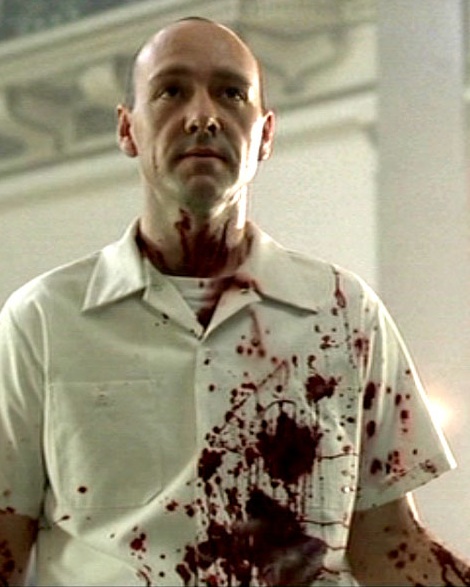
Below is an alleged shot of the election worker in question, taken shortly after he admitted to his negligence:

On a platter

I realize that political columnists must circulate amongst some pretty unsavoury people in the course of gathering Common Wisdom to be passed on to their readers, but what kind of crowd has the Toronto Star's James Travers been hanging out with to be able to start a piece on the Liberal leadership race thus:
In one of those moments that hushes a dinner party, an astute student of federal politics bet his wife against a serving platter that the next Liberal leader won't be Stéphane Dion.


"What's more, I'll wager an evening with the au-pair that Ignatieff takes it on the first ballot!"

Monday, November 13, 2006

It's a thin line...

... between healthy skepticism and outright paranoia.

Check out comments #1 and #4 here.

I especially like the idea of a “can’t pull a needle out of its ass” school of writing. What's that, Humber? Aren't the good writers the ones who didn't put a needle in their ass in the first place? (Which leaves out Jim Carroll, I guess. Haw haw.) There is a cardinal rule of criticism being broken in these comments – that bad writing should never be met with more bad writing.

Thursday, November 09, 2006

Gopnik on Richler

I was all ready to cringe at Adam Gopnik's excerpt on Mordecai Richler in Macleans – so many writer-admirers get Richler wrong simply through being too, well, admiring. Gopnik, however, does an excellent job of mapping out Richler's precise boundaries as a writer, his limitations. (Admittedly, he tends to posit them simultaneously as strengths, which is fair enough, though I don't agree with the assertion that Richler actually outshone his British contemporaries). I was really knocked back by the passage below, because it gets at something I've been struggling to articulate for a while, in terms of what is missing in a lot of contemporary Canadian fiction:
Where the American Jewish novelists were American first of all – "I am an American, Chicago born" is how Augie March greets us – and could lay claim to a whole literature, to Melville and Whitman as much as to their parents' jokes, Richler, like the Australian and Caribbean writers, had first to show that what he was writing about existed at all. He had to show that a language and lore existed before he could attach it to anyone else's tradition.

The satiric, deprecatory tone that he shared with Amis and Braine was therefore allied in his writing to a larger ambition – he had to write about a city (and country) that didn't quite know it was one, about the manners of a tribe who hadn't been told they had them. The urge to inventory a reality that everyone else thought was merely a dependency, one that didn't really count, is present everywhere in his novels, and it creates an unwilled expansiveness, an appetite for setting down experience, that feels less claustrophobic than the worlds of his English contemporaries. It was the same tone, but they were describing a world shrinking inwards. He was describing one pushing out.

So he had to give form to a world before he could make fun of it, and the two ambitions were so closely allied – the affectionate urge to inventory a city and tribe already vanishing as he wrote of them; the satiric urge to mock their narrowness and pretensions – that they became indistinguishable.

(Emphasis mine.)

Giller Chatter vs the code of silence

In lieu of posting the entire discussion here, which would mess up my pretty blog, I have stolen my concluding point from the Giller postmortem now online at Good Reports.

(Also up at The Danforth Review)

Rant ho!

**********

It's not really their fault, but I would be a lot more generous to this jury if there was some effort made to break this code of silence that surrounds the selection process. Booker judges routinely spill the beans on what went on in the meetings, and why certain books got picked and others didn't. I think there needs to be more transparency about the whole thing, not because I think there are conspiracies at work, but because it would be interesting, period, and would genuinely add to the understanding of how writing and publishing and the rest of it works. There is a vested interested in maintaining this illusion that books appear before us and are rewarded through means far too sacred and rarified for us to ever comprehend. For us mere mortals to be told that, say, Vincent Lam's was the book the entire jury could agree on, but was no one's first pick (not saying that was the case, but it's just as likely as any other scenario) would not disillusion us all and send us spiraling into doubt about the worth of awards. And yet, we are supposed to take everything the jury says at face value and believe they picked the absolute "best books."

Imagine if, say, Munro admitted afterward that there was no way she was going to vote for the Windley because it was too Munro-esque? (Again, just a wild theory.)

Instead, we are left to indulge in the silliest CanLit Kremlinology every single year.

Why Canadian publishing people have not yet learned the lesson of publicist-planted gossip and leaked songs as promotion is baffling to me, and just further cements CanLit's reputation as an institution always a few decades behind the times. People love dirt; they get excited about it, and if they get excited about something, they are more likely to see the thing behind it all - books - as something with a bit of life to it.

Is finding out why and how the jury picked the books they did really too much to ask?

    A very subtle and funny writer - one I've become obsessed with over the past year - in a decidedly Muriel Spark mood. Imagine The Pr...