My piece in the Globe and Mail on mysterious Italian novelist Elena Ferrante.
How about you? What are you up to? How have you been?
Sorry to hear!
Saturday, October 04, 2014

Monday, April 28, 2014
More books I read for money: featuring David Letterman, Bruce McCall, Gary Shteyngart, the guy who co-wrote "Babe: Pig in the City," and more!
Omnibus blog posts are the best/only kind of blog posts. And so:
Review of This Land Was Made for You and Me by Bruce McCall and David Letterman.
Review of Little Failure by Gary Shteyngart (to which Mr. Shteyngart replied with some Twitter shouting).
Review of Today I Am A Boy by Kim Fu.
Review of The Full Ridiculous by Mark Lamprell. (Who co-wrote Babe: Pig in the City! Which I love! This book not so much!)
Bonus content: getting drunk on CanLit! Watching UFC with poets!
Review of This Land Was Made for You and Me by Bruce McCall and David Letterman.
Review of Little Failure by Gary Shteyngart (to which Mr. Shteyngart replied with some Twitter shouting).
Review of Today I Am A Boy by Kim Fu.
Review of The Full Ridiculous by Mark Lamprell. (Who co-wrote Babe: Pig in the City! Which I love! This book not so much!)
Bonus content: getting drunk on CanLit! Watching UFC with poets!
Monday, December 09, 2013
Books I've Been Paid To Read Lately
Life is still elsewhere, but here are some recent reviews:
Of Chris Hadfield's A Guide to Life on Earth.
Of Bill Bryson's One Summer.
Of Eric Schlosser's terrifying Command and Control.
Of The Panopticon by Jenni Fagan.
Of Scatter, Adapt and Remember by Annalee Newitz.
Of Time Reborn by Lee Smolin.
As Daffy Duck might say if he reviewed books, it's not nearly a living.
Of Chris Hadfield's A Guide to Life on Earth.
Of Bill Bryson's One Summer.
Of Eric Schlosser's terrifying Command and Control.
Of The Panopticon by Jenni Fagan.
Of Scatter, Adapt and Remember by Annalee Newitz.
Of Time Reborn by Lee Smolin.
As Daffy Duck might say if he reviewed books, it's not nearly a living.
Monday, July 29, 2013
David Rakoff's Love, Dishonor, Marry, Die, Cherish, Perish
My review of David Rakoff's posthumous novel in The National Post.
Sunday, April 28, 2013
Fetherling's footnotes
The best group of footnotes in George Fetherling's The Writing Life: Journals 1975 - 2005 (on p. 88):
17 Sarah Sheard (b. 1953), novelist, author of Almost Japanese
18 Douglas Gibson (b. 1943), McClelland & Stewart publisher
19 Lee Harvey Oswald (1939 - 1963), alleged assassin of John F. Kennedy
Monday, April 01, 2013
The Fun Parts by Sam Lipsyte
My review of Sam Lipsyte's latest in The Toronto Star:
There is a very good reason to read a book about unlikeable losers. Books like that can be very, very funny. And Lipsyte is a very funny writer. The one thing he is constantly doing — even when he maybe shouldn’t, at least not so much — is being funny.
Sunday, March 10, 2013
You Will Be To Blame
"I was tired from the drive - all the way up to Dalgleish, to get him, and
back to Toronto since noon - and worried about getting the rented car back
on time, and irritated by an article I had been reading in a magazine
in the waiting room. It was about another writer, a woman younger,
better-looking, probably more talented than I am. I had been in England
for two months and so I had not seen this article before, but it crossed
my mind while I was reading that my father would have. I could hear him
saying, Well, I didn't see anything about you in Maclean's. And if he
had read something about me he would say, Well, I didn't think too much
of that write-up. His tone would be humorous and indulgent but would
produce in me a familiar dreariness of spirit. The message I got from
him was simple: Fame must be striven for, then apologized for. Getting
or not getting it, you will be to blame." - from "The Moons of Jupiter"
If I were ever to start a tumblr, it'd be called "Alice Munro Just Killing It."
If I were ever to start a tumblr, it'd be called "Alice Munro Just Killing It."
Monday, January 14, 2013
The new new escapism
The New York Times drops a bombshell:
"There is a reason for our attraction to these shows other than that they simply entertain us. 'Downton' and today’s other quality television series also promise a welcome escape from a muddled, technology-addled existence."
Also applies to movies, novels, poetry, music, friends, children, bike rides, food, alcohol, sex, masturbation, and sleep.
"There is a reason for our attraction to these shows other than that they simply entertain us. 'Downton' and today’s other quality television series also promise a welcome escape from a muddled, technology-addled existence."
Also applies to movies, novels, poetry, music, friends, children, bike rides, food, alcohol, sex, masturbation, and sleep.
Sunday, September 30, 2012
J.K. Rowling's Casual Vacancy has much casual brutality
My review of a new novel by a promising up-and-comer in the Toronto Star.
A taste:
A taste:
The obvious thing for [Rowling] to have done would have been to write a kind of methadone novel for Potter addicts, something that bridged the gap between the world of Hogwarts and our own. No one would’ve begrudged her writing a mystery story, or a work of castle-heavy historical fiction, or even a work of grown-up fantasy (i.e., wizards with sex lives and drinking problems). Instead, she has written a book that plants its flag right in the middle of some very dark territory, where curses abound, but spells are non-existent. Readers looking for a little of that old Potter magic will be shocked by the new novel’s numerous scenes of drug abuse, marital discord, domestic violence, and unbridled despair. It’s the equivalent of Raffi making a late-career swerve into death metal, or Mr. Dressup doing David Mamet.
Monday, June 11, 2012
Welsh and Brooks
Just flew down from the Fortress of Solitude to offer this review of Irvine Welsh's Skagboys and Ben Brooks's Grow Up in lieu of something good. They say you should start an idle car at least once every couple of months just to make sure the engine can still turn over.
Back to the fortress.
Back to the fortress.
Monday, July 11, 2011
Captivity: 118 Days in Iraq and the Struggle for a World Without War by James Loney
My review of James Loney's Captivity appeared in the Toronto Star yesterday.
Get the whole scoop here.One of the enduring myths of contemporary Western society is that we are a culture desperate to be tested. We are a fatted, decadent, overly complacent bunch (the myth goes), which makes us yearn to be stripped of our comforts (at least for a little while) to see how we hold up under pressure.
Comfort is inauthentic; stress and fear and adrenaline are “reality.” How would you act in an extreme situation? How strongly held are your ideals, and how quickly would you abandon them in order to survive?
The problem is that in reality, a true testing of one’s ideals never yields a clean result. When push becomes shove, and shove becomes kick, ideals splinter and multiply. Every breath becomes a test, and we often only survive to be tested again.
Monday, June 20, 2011
Review two-fer: The Meagre Tarmac by Clark Blaise and A Description of the Blazing World by Michael Murphy
Saturday, May 28, 2011
The Use and Abuse of Literature by Marjorie Garber
I haven't exactly been riding this blog and putting it away wet lately - in fact, I only just realized I hadn't posted this review of Marjorie Garber's The Use and Abuse of Literature, which ran in the Toronto Star last weekend.
Here's a taste:
Here's a taste:
The jacket copy for Garber’s book positions it as something polemical, even reactionary, in the vein of E. D. Hirsch’s Cultural Literacy (1987) and Dinesh D’Souza’s Illiberal Education (1991), but if anything, it is a witty and fleet-footed argument against literary polemics. In fact, for the first few chapters, it’s a little tough to work out what ultimate point Garber is trying to make. There are seeming digressions into scholarly disputes of the past, the use of literary allusions, the rise of graphic novels, the idea of a literary canon and even a brief look at some of the other books that use the phrase “the use and abuse of …” in their titles.
Eventually, however, it becomes clear that this digressive method is the message: Literature is not something about which one should write manifestoes, but something that needs to be seen as uniquely welcoming to contradiction and a diversity of thought. It also becomes clear that Garber sees both the “use” and the “abuse” of literature as two sides of the same coin — the inevitable distortions of meaning merely create new meanings.
Monday, April 04, 2011
Are You Married to a Psychopath? by Nadine Bismuth
Interrupting my long winter's nap* here to note that my review of Nadine Bismuth's Are You Married to a Psychopath? ran in the Toronto Star yesterday.
A taste:
Read the whole thing here.
* the semi-bitter, semi-sweet irony being that I have probably slept less in the past few months, thanks to daily pre-dawn novel-writing sessions, than I have at any point in my life - other than those times when my kids cut teeth. As with that teeth-cutting, I hope all this pain, frustration, and fatigue results in something bright, hard, and useful, but the odds are against me.
A taste:
Though most of these 10 stories feature young, urban women whose sense of self-esteem relies heavily on the whims and fancies of their male counterparts, Bismuth’s fiction is far too scathing, intelligent and clear-eyed to be considered Chick Lit. There are no Cinderellas here, no Prince Charmings, no problem-dissolving baby bumps and no happily-ever-after.
Bismuth is singularly interested in laying out the problems faced by fallen women in a fallen world, but makes no guesses as to where redemption may lie. She is doing literary forensics, not spinning fairy tales.
Read the whole thing here.
* the semi-bitter, semi-sweet irony being that I have probably slept less in the past few months, thanks to daily pre-dawn novel-writing sessions, than I have at any point in my life - other than those times when my kids cut teeth. As with that teeth-cutting, I hope all this pain, frustration, and fatigue results in something bright, hard, and useful, but the odds are against me.
Wednesday, March 16, 2011
Monday, February 07, 2011
Apocalypse for Beginners by Nicolas Dickner
My review of Nicolas Dickner's second novel in the Toronto Star.
A wee sniff:
Thee whole thing.
[Edit: Corrected the spelling goof in Dickner's name.]
A wee sniff:
It’s getting harder and harder to make the end of the world seem interesting. Familiarity breeds contempt, even when it comes to the something as big as the apocalypse.
Indeed, among the more recent depictions of the end of days — and there have been so many, usually with war, plague, zombies, ecological disaster or some combination of all four playing a role — only a precious few have treated it with anything close to seriousness or dread. At a time when publishers are offering up tongue-in-cheek zombie survival guides and post-apocalyptic cookbooks, a work like Cormac McCarthy’s The Road is an anomaly. (And even that was seen as approachable enough for Oprah viewers.)
Montreal’s Nicolas Dickner, in his second novel, eschews neither comedy nor gravitas in his own take on the end of the world, but the register he sticks to most faithfully is boredom. His is a story in which the concept of apocalypse is more a source of personal frustration than anything else. Unfortunately, his book enacts that frustration and boredom a little too faithfully.
Thee whole thing.
[Edit: Corrected the spelling goof in Dickner's name.]
Friday, January 07, 2011
The Symbol of Overly Grand Metaphor
The film itself may end up being the most brilliant thing since the last most brilliant thing ever, but the trailer for Tree of Life looks like a high-budget parody of a credit card commercial. ("For all those times when you look back on your family, with their strange habit of only doing and saying things that were thematically significant, and wonder if maybe there is more to life than a bunch of pretty images and some warmed-over metaphors, there is Mastercard.")
It's like a David Attenborough documentary being raped by Oprah's Book Club. I only say this because I just read, for the four thousandth time, that this very trailer is proof there is hope for cinema yet. This looks like the kind of Serious Meaningful Art that can't stop telling you it is Serious Meaningful Art. The difference between this and porn is that porn tries to space out the money shots a little.
I'll give Mallick this: the trailer actually manages to be hokier and less subtle than the film's title. (And this is from someone who has been raving to all who will listen about a movie entitled Another Year...)
It's like a David Attenborough documentary being raped by Oprah's Book Club. I only say this because I just read, for the four thousandth time, that this very trailer is proof there is hope for cinema yet. This looks like the kind of Serious Meaningful Art that can't stop telling you it is Serious Meaningful Art. The difference between this and porn is that porn tries to space out the money shots a little.
I'll give Mallick this: the trailer actually manages to be hokier and less subtle than the film's title. (And this is from someone who has been raving to all who will listen about a movie entitled Another Year...)
Sunday, December 19, 2010
Beauty & Sadness by André Alexis, with extra sadness
My review of André Alexis's Beauty & Sadness gets the full-page + cartoon treatment in the Toronto Star.
A wee taste:
Read the whole thing here.
ADDED: Just as night follows day and drunk-dialing leads to grief, Mr Alexis has offered his own lower-case thoughts on my thoughts on his thoughts in the comments.
A wee taste:
It’s hard not to think, while reading André Alexis’s Beauty and Sadness, that its author got the title back to front. What moments of beauty there are in this intriguing, odd and occasionally perplexing mix of short fiction, literary essays and personal memoir are thoroughly drenched in sadness. In the book’s introduction, Alexis, who is in his early 50s, writes that “I have come to a time in my life when leave-taking, death, and change have begun to seriously impinge on my imagination.”
Read the whole thing here.
ADDED: Just as night follows day and drunk-dialing leads to grief, Mr Alexis has offered his own lower-case thoughts on my thoughts on his thoughts in the comments.
Wednesday, December 15, 2010
Are you feelin' it?
The parts of my mind not currently occupied with visions of dancing sugarplums have been taken hostage by this new novel, which I am determined to have done-ish* by very early 2011 - as in end of January, if things go swimmingly. So allow me a brief digression on the subject of the supposed war between feelings and craft in the making of fiction....
From the Dept of False Dichotomies:
"I spent my entire youth writing slowly with revisions and endless rehashing, speculation and deleting and got so I was writing one sentence a day and the sentence had no FEELING. Goddamn it, FEELING is what I like in art, not CRAFTINESS and the hiding of feelings." - Jack Kerouac
To which I say: exactly... exactly the opposite of all that.
Or, less glibly, I say: I like feelings in fiction, too! (Whatever "feelings" means, but let it stand for now.) However, I have discovered that, for myself at least, the feelings that come across in fiction that has not been put through a process of "revisions and endless rehashing, speculation and deleting" are the most obvious ones, the most superficial, the least interesting. The people I am interested in writing about do not spend their days endlessly emoting, which may mean I need to find more interesting subjects, but if it doesn't, then those people's feelings need to be teased out through much careful work, not violently harvested with a rusty spork. We'd all like the people around us to be emotionally honest and authentic and in touch with their feelings, etc, but in the real world, and especially in this country and this culture, feelings often get hid. So it's down to detective work, not the kicking down of random doors.
There's more life and pleasure in unholy mess to inert precision, but I'd rather not have to choose between the two, preferring to abide by the old Led Zeppelin ideal of "tight but loose."
Now, back to it.
* that is: done, but for the fretting, re-revising, re-working, and the slaughter of all darlings who ignored previous evacuation orders.
*****
Also, if you really prefer raw, unrehearsed FEELING, there's always Nicolas Cage:
From the Dept of False Dichotomies:
"I spent my entire youth writing slowly with revisions and endless rehashing, speculation and deleting and got so I was writing one sentence a day and the sentence had no FEELING. Goddamn it, FEELING is what I like in art, not CRAFTINESS and the hiding of feelings." - Jack Kerouac
To which I say: exactly... exactly the opposite of all that.
Or, less glibly, I say: I like feelings in fiction, too! (Whatever "feelings" means, but let it stand for now.) However, I have discovered that, for myself at least, the feelings that come across in fiction that has not been put through a process of "revisions and endless rehashing, speculation and deleting" are the most obvious ones, the most superficial, the least interesting. The people I am interested in writing about do not spend their days endlessly emoting, which may mean I need to find more interesting subjects, but if it doesn't, then those people's feelings need to be teased out through much careful work, not violently harvested with a rusty spork. We'd all like the people around us to be emotionally honest and authentic and in touch with their feelings, etc, but in the real world, and especially in this country and this culture, feelings often get hid. So it's down to detective work, not the kicking down of random doors.
There's more life and pleasure in unholy mess to inert precision, but I'd rather not have to choose between the two, preferring to abide by the old Led Zeppelin ideal of "tight but loose."
Now, back to it.
* that is: done, but for the fretting, re-revising, re-working, and the slaughter of all darlings who ignored previous evacuation orders.
*****
Also, if you really prefer raw, unrehearsed FEELING, there's always Nicolas Cage:
Constant commentary by the wayside
Van Dyke Parks' Song Cycle, despite being one of the my absolute favourite rekkids, is one I am usually hesitant to proselytize on behalf of, because it's an either/or, hate/love kind of rekkid, and even I hate the idea of an avant-whimsical take on Americana. But as with most great art, what doesn't work in theory, can utterly astound in practice. Or just grate on your nerves. This one does the former for me. That it does the latter for most people is absolutely not a sign of poor taste or philistinism or anything like that - a lot of very wise music-minded people can't stand the thing. It just does what it does, regardless, mincing around in its own little world where Charles Ives writes ballet for B'rer Rabbit.
Here is the man in a NYC radio studio just this year, showing again why Song Cycle can only be loved or hated:
Here is the man in a NYC radio studio just this year, showing again why Song Cycle can only be loved or hated:
Subscribe to:
Posts (Atom)
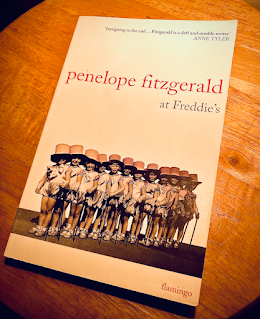
A very subtle and funny writer - one I've become obsessed with over the past year - in a decidedly Muriel Spark mood. Imagine The Pr...