Wednesday, September 16, 2009
IFOA's dirty thirty
I have a fairly puffy piece about the IFOA's thirtieth anniversary up over at Open Book.

Tuesday, September 01, 2009
Driven lets me drive
 The good people at Driven magazine, for which I serve as fiction editor, have asked me to become the content-monkey for their web site. Starting today and continuing on until civilization collapses or they get tired of me, I'll be putting something up there every weekday. There'll be discussions of culture, politics, art and the rest of it, links to odd/interesting things around the weboverse and beyond, original short-short fiction (not by me), the occasional review of something, and probably a whole lot of the kind of hoarse chortling that is already the defining feature of this here blog.
Go take take a look.
Sunday, August 30, 2009
One damned thing after another
Anyone who has read the novel I keep hawking along the right side of this blog – or tried to; or considered it, then abandoned the idea after reading a description of the "plot" – would probably not be shocked to discover that I plan to rent and watch this foot-dragger of a movie:
At 201 minutes, it’s a tremendously challenging affront to convention: In a typical sequence, Jeanne discovers she only has one potato, she goes to the store to buy a bag of potatoes, and she peels the potatoes one by one. Yet the miracle of the film is that her daily tasks, which she executes with admirable fastidiousness, hint at deep psychological stress. It’s like watching her unravel in slow motion.It might also be like watching paint dry, but we shall see.
Wednesday, August 26, 2009
Dancing days
Having cleared through a pile of freelance work, giving myself a few days' off before I have to tackle the next pile, I feel an awful lot like this:
Friday, August 21, 2009
I see a darkness
I lost power for about 12 hours, and had muddy water gushing in my door like my apartment was a trawler in the middle of the ocean during a squall, but I got off easy.
Tuesday, August 18, 2009
You picked a fine time to leave me, loose wheel
Just over 24 hours after writing some nice things about my current bike in the post below, the stupid thing seizes up on me whilst on my way to take the kids to the pool.
(By which I mean actual kids and an actual pool, not that I was planning to take a dump.)
(Sorry. Honestly.)
So now I'm back in the drag-the-disabled-bike-t0-the-repair-shop-and-wait-forever game, one I've avoided for years mostly by only riding bikes so dilapidated and poorly put together that the first crisis was also the last – a mechanical problem that would have been a minor setback in a newer bike hit mine like a flu in a rest home, wiping the thing out.
Anyway, this is what I get for writing something nice on this blog... Lesson learned.
(By which I mean actual kids and an actual pool, not that I was planning to take a dump.)
(Sorry. Honestly.)
So now I'm back in the drag-the-disabled-bike-t0-the-repair-shop-and-wait-forever game, one I've avoided for years mostly by only riding bikes so dilapidated and poorly put together that the first crisis was also the last – a mechanical problem that would have been a minor setback in a newer bike hit mine like a flu in a rest home, wiping the thing out.
Anyway, this is what I get for writing something nice on this blog... Lesson learned.
Monday, August 17, 2009
I've got a bike, you can ride it (on the sidewalk) if you like
I did a opinion/rant thing for The Globe and Mail's T.O. section this weekend, all about sidewalks and bikes, bikes and sidewalks.
Read it here.
The last time I wrote something about urban biking for the Globe, there was a mild shitstorm in the comments. This time, there's only a couple of comments – both think I'm full of shit, though for different reasons. Story of my life.
And in case you're wondering, I end up riding on the sidewalk a lot, but always, you know, nicely.
ADDED: I'm pretty happy with the bike I've got right now – a cheap, rusty Pee Wee Herman-type thing with no gears and a back-pedal brake that clanks and scrapes along like the Tin Man in a downpour; I call it "The Red Racket" – but when next I buy a new one, I plan to get a Beater.
Read it here.
The last time I wrote something about urban biking for the Globe, there was a mild shitstorm in the comments. This time, there's only a couple of comments – both think I'm full of shit, though for different reasons. Story of my life.
And in case you're wondering, I end up riding on the sidewalk a lot, but always, you know, nicely.
ADDED: I'm pretty happy with the bike I've got right now – a cheap, rusty Pee Wee Herman-type thing with no gears and a back-pedal brake that clanks and scrapes along like the Tin Man in a downpour; I call it "The Red Racket" – but when next I buy a new one, I plan to get a Beater.
Saturday, August 08, 2009
Bad times are here again
While re-working some parts of my new novel that were written a few years ago, I came across a reference to a golf course that had hit hard times during "the recession" – i.e. the previous one. Actually made me laugh a little (the laugh of the damned) to have to reword it to reflect contemporary shitty reality.
Tuesday, August 04, 2009
Knobjet trouvé
There is no possible way for this article to end well, given how it begins:
When writer Sheila Heti received a photo of a white porcelain shoe – adorned with painted roses and the words “Cape Cod” in gold script – she had no idea who had possessed the tacky tchotchke before it was relegated to a thrift-store shelf.“Probably a fancy lady who had a fireplace and some lace?” she ventures with a giggle.
But just because the shoe had no official history didn't mean Heti couldn't make one up. Last week, she posted a story about its (purely fictional) significance along with the knick-knack on eBay – one of dozens of items being auctioned off as part of an art experiment dubbed Significant Objects.
I don't think those knick-knacks are the only things with purely fictional significance here...
ADDED: I could probably go on a rant about the teeth-grinding sense of cultural entitlement inherent in an "art experiment" that involves embroidering random objects with clever, vaguely patronizing narratives for the amusement of a small group of foppish lovelies, but then I'd have to remember that I write literary fiction and, well, glass houses and all...
Saturday, August 01, 2009
Survey says
Book-talk in a nutshell:

Positive cliché, negative cliché, or "pass".
To be fair, after those pensées on Summer reading the Globe ran a couple of weeks ago, which yielded more preciousness than a diamond mine, this at least has the advantage of brevity.

Positive cliché, negative cliché, or "pass".
To be fair, after those pensées on Summer reading the Globe ran a couple of weeks ago, which yielded more preciousness than a diamond mine, this at least has the advantage of brevity.
Wednesday, July 29, 2009
Saturday, July 25, 2009
Hello Dolly
The angel-voiced and extravagantly coiffed Dolly Parton – whom I interviewed last week for Maclean's magazine (not sure yet when it will be published) – seen here in a long-ago performance (with Porter Wagoner) of one of my current favourites:
Tuesday, July 21, 2009
Grave, grave Anne Michaels
Anne Michaels has an essay in The Atlantic on... reading, or... culture, maybe... books?
Tense up your buttocks, Gentle Reader, we’re going in:
Moving on….
Somehow, I think they’re all reading the Toronto Sun. Or The Da Vinci Code.
Who said Canadian literature was predictable?
I heard a comedian once say that all British humour can be reduced to “Toilet” and “Royalty.” Which sounds like an infinitely more interesting basis for a culture.
On the other hand, I plan to start a band called “Wilderness and the Immigrant Experience.” We’ll never play a single show – okay, maybe a Writers’ Union general meeting or two – but we’ll all buy ourselves houses with the proceeds from our many Canada Council grants.
Tense up your buttocks, Gentle Reader, we’re going in:
It is the most obvious of observations, that as humans we are entangled—by intimate experiences such as parenthood, death, love, and by commerce, culture, politics. And today we are entangled as never before—by the global consequences of our actions, small and large.She’s right: that is the most obvious of observations. No worries, though, she can easily save this opening from banality with a novel metaphor.
A dolphin in captivity is taught tricks to please a human audience and then, once released, teaches these skills to wild dolphins an ocean away.Amazingly, this has been documented. (Though, if you think about it, humans have been doing this for a while. We’re Number One! We’re Number One! Suck on that, dolphins!) Fucking with nature almost always has hidden repercussions, but in this case, the idea of trained dolphins teaching tricks to wild ones is fairly cool. Though it’ll be a real pisser when they realize that beach balls and “Danger Zone” by Kenny Loggins do not exist in nature.
Moving on….
And now, of course, another entanglement: in the local high street of the Western world, in the length of two blocks, about a minute’s walk from home, the shopkeepers come from everywhere—Italy, Estonia, Mexico, Thailand, Britain, India, Germany, China, France, Sri Lanka, Trinidad, Spain, Poland, Jamaica, the Czech Republic, Japan, Greece.That’s a minimum of 17 shopkeepers of different backgrounds in a single two-block stretch. Imagine what that “local high street” looks like during World Cup.
At the local milk-mart, the man behind the counter reads Goethe’s Faust in Korean.Yes, and the butcher reads Robert Burton’s The Anatomy of Melancholy in Farsi, the cobbler reads Tolstoy’s Anna Karenina in Swahili, and the haberdasher reads the complete works of Virginia Woolf in Cree….
Somehow, I think they’re all reading the Toronto Sun. Or The Da Vinci Code.
Though this kind of multiculturalism through labor migration or political exile has become commonplace, one question never loses its poignancy, no matter how often it is asked: Do we belong to the place where we are born, or to the place where we are buried?Some would put that as “Do we belong to the place where we grew up, or to the place where we live now?”, but Anne is an award-winning novelist – it’s her job to soak this stuff in literary sauce.
When one is dispossessed of everything—home, country, landscape—what is left?Faust?
Language, memory, one’s own body.Oh. Well, if ye ain’t got nothing, says Anne, ye can always have a talk, have a think, or have a wank.
Not too long ago—an instant ago, in terms of evolutionary history—we knew one thing with a fair amount of certainty: the place where we were born would likely be the place where we would die.I’m not feeling so good, myself.
We are marinated in our childhoods, in the places of our earliest memories.Ew.
Even when a writer decides never to write overtly about his childhood—perhaps the food of that childhood is too hot and burns the tongue, or is too cold to be eaten with pleasure—nevertheless, for a writer, it is a metaphorical meal that must be eaten, even if only in private.Thus are the meals of our childhood preserved in the Tupperware of memory, burped by emigration and displacement, left at the back of the fridge by time and loss, until served up, with most of the moldy parts cut out, by internationally celebrated literary novelists.
In Canada, we have been politically stable enough to be able to define a national literature by way of geographical region: Arctic, prairie, east and west coasts, the looming wilderness. In some sense, this definition has not changed. Two great themes weave through our literature—our relationship with the wilderness, and the immigrant experience. These themes were combined even in the beginnings of published writing in this country, and this continues.Wilderness and the immigrant experience. Wilderness and the immigrant experience. Wilderness and the immigrant experience.
Who said Canadian literature was predictable?
I heard a comedian once say that all British humour can be reduced to “Toilet” and “Royalty.” Which sounds like an infinitely more interesting basis for a culture.
On the other hand, I plan to start a band called “Wilderness and the Immigrant Experience.” We’ll never play a single show – okay, maybe a Writers’ Union general meeting or two – but we’ll all buy ourselves houses with the proceeds from our many Canada Council grants.
The changes now, in global influence and global consequence, in a global witnessing, will of course change what there is to say, and how we say it.We’ll have to say “global” a lot more, for one thing.
But will it change how we read? What will a national literature mean to a society that reads globally with ease, absorbing novels online and downloading instant translations of books?Kids today, with their online absorptions and instant translations…
Despite the new ease with which we cross borders and enter the experiences of others, some truths will not change: love finds us wherever we are, a child is born in only one place, the ground where we bury our dead becomes sacred to us; these places do not belong to us, we belong to them.And that which is thrust heavenward, must soonafter return to the rocky ground from whence it came. What goest around, does surely comest in that same direction, with time.
And where does a writer metaphorically wish to be laid to rest? In a book, in a reader.Were these Frank McCourt’s last wishes? Because I’m not sure that’s even hygienic.
Not laid to rest in terms of immortality, but in terms of common experience; laid to rest in this common ground. A writer may be born in one place and write in another—but who claims him? The reader—who may live in a very different place and in a different time. In this sense alone, perhaps, globalization cannot be considered a new idea.Actually, Anne, none of what you’ve written here can be considered a new idea. Except the for the dolphin bit – again, that’s pretty cool.
A national literature is made not only by writers, but by readers. Recently, a project was launched in Toronto to “bookmark” the country; passages of Canadian literature, set meaningfully in real locations, will be commemorated in those actual locations. We can cross an ordinary bridge or an intersection and read a passage describing a fictional event that takes place where we stand. Where we stand, there is a story. And perhaps that is the simplest, and most privileged, definition of what a national literature is.You remember that one, don’t you? Methinks Anne is looking for some plaque action of her own.
When people are dispossessed, a national literature can reside in a single voice. What makes a home for words is a reader; and what makes a home for a reader is words.And what makes a reader for words is a home; and what reads words for a home is a make; and home readers make what a is.
When the dead cannot be laid to rest in ground that remembers them, sometimes literature is the only grave we have. And that grave is one way a migrant claims a place in his adopted country—a place, ironically, for the living.“Sometimes literature is the only grave we have” – and people say I hate books…
Monday, July 20, 2009
The one where I interview Chandler
The new issue of Fashion magazine has an interview I did with Chandler Burr, the New York Times' perfume critic and the author of a brand-spankin' new novel about Hollywood and book clubs and Jewishness and acceptance.
(It's not online, but you can see the table of contents here.)
(It's not online, but you can see the table of contents here.)
Tuesday, July 14, 2009
Hip hop hegemony
The Jay-Z/Game beef from a foreign policy perspective. Seriously.
It's a bit like reading an analysis of what a given pro wrestler "needs to do" to get back on top (when the answer is always "follow the script, tight pants"), but it's fascinating nonetheless and an efficient time-waster.
It's a bit like reading an analysis of what a given pro wrestler "needs to do" to get back on top (when the answer is always "follow the script, tight pants"), but it's fascinating nonetheless and an efficient time-waster.
Monday, July 13, 2009
Fuck book magazines, too
My deskmate Steven "Dubya" Beattie (who often plays the Felix Ungar to my Oscar Madison, or the Frank Burns to my "Hawkeye" Pierce, or the Chip to my Dale - anyway, he's clean and I'm messy, he's careful and I'm sloppy, he takes his job seriously and does it well while I spend most of my time thinking up dirty puns for headlines) has an essay in the new issue of Canadian Notes & Queries about the fiction of Anne Michaels Ondaatje that mines a bit of potty-mouthed anti-literariness from my novel for it's title, and quotes the source to boot.
Give it a read here.
(By the way: the Patrick in my book is not named after the Patrick in Ondaatje's. I didn't even notice that until the book (mine, that is) was already written.)
Give it a read here.
(By the way: the Patrick in my book is not named after the Patrick in Ondaatje's. I didn't even notice that until the book (mine, that is) was already written.)
Saturday, July 11, 2009

Wednesday, July 08, 2009
Dinosaur Sr.
I'm amazed these guys are still at it – and in exactly the same way they were twenty years ago:
They've mostly dropped the Sonic Youthesque atonalities for guitars that roar clean a la Neil Young, but that's what getting older will do to you. (Even if it doesn't seem to be doing it to, well, Sonic Youth.)
This sound hasn't really been my thing for a while now (as far as "comebacks" go, I was more excited/intrigued by the new DOOM and the new Mos Def), but I've been listening to Farm a lot lately, almost without meaning to. There's not a single moment on the record that will come as a surprise, but for some reason, they pull it off. It's the post-rock equivalent of AC/DC, if the AC/DC were still able to do what they do with some dignity, which they mostly don't. (Except for live, or so I've been told.)
They've mostly dropped the Sonic Youthesque atonalities for guitars that roar clean a la Neil Young, but that's what getting older will do to you. (Even if it doesn't seem to be doing it to, well, Sonic Youth.)
This sound hasn't really been my thing for a while now (as far as "comebacks" go, I was more excited/intrigued by the new DOOM and the new Mos Def), but I've been listening to Farm a lot lately, almost without meaning to. There's not a single moment on the record that will come as a surprise, but for some reason, they pull it off. It's the post-rock equivalent of AC/DC, if the AC/DC were still able to do what they do with some dignity, which they mostly don't. (Except for live, or so I've been told.)
Monday, June 29, 2009
The Pleasures and Sorrows of Work by Alain de Botton
My review of de Botton's new book in the Toronto Star.
Subscribe to:
Posts (Atom)
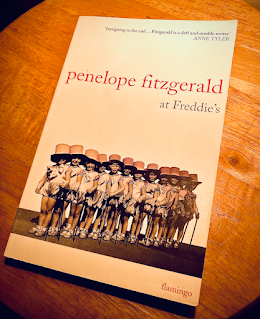
A very subtle and funny writer - one I've become obsessed with over the past year - in a decidedly Muriel Spark mood. Imagine The Pr...
-
Mark Steyn is a dangerous idiot with a suspiciously homophobic streak for a bearded, show tunes-loving man who is drawn to big, strong, auth...
-
My review of André Alexis's Beauty & Sadness gets the full-page + cartoon treatment in the Toronto Star . A wee taste: It’s hard no...
-
In the December issue of Books in Canada – the one with that 27,000-word (!!) defence of Conrad Black – there is a review by poet David So...
