Wednesday, June 03, 2009

I don't know about everybody, but I'm working for the weekend, at least

Welcome, welcome – have some whine:

In addition to my day job, which is unusually hectic right now, I have a review of the new Alain de Botton book due, I just finished a short books article for Fashion magazine yesterday, I am in the middle of editing a wrestling memoir (!), I am interviewing a lit-magazine editor this afternoon, and my lowly second novel picked this moment to demand daily, break-of-dawn labour (and I am abiding, mostly happily).

Plus: my son's baseball team seems to play every other night, and my daughter is continuing her descent into full-on hellion status.

This would all be just fine, were I not, at heart, a lazy goodfornothing who would rather lie around and re-read Kingsley Amis novels all day.

Was it not Huey Lewis (and his News) who once sang, "all I need is a couple days off"?

Wise words, Mr Lewis, wise words.

Sunday, May 31, 2009

Toronto is a pot o' gold

Pretty stunning rainbow arcing over the city last night. From where I was seeing it – nine floors up, way out yonder in the Distillery District – it appeared to be touching down right next to a docked tanker ship:


The city itself looked fairly otherwordly after the storm, too:

Saturday, May 30, 2009

Kill us now, let Zordog sort us out...

When inquisitive aliens, visiting our scorched, lifeless planet many millions of years from now – after the total economic collapse, after the brutal automotive duels in the wastelands over gasoline, after the nuclear holocaust, after the rise of the flesh-eating zombies, after the ascendancy of intelligent (damn dirty) apes over humans, after the division of humankind into Morlocks and Eloi, after the ecological cataclysm that eliminates all life on Earth – this will be the kind of cultural artifact they will study to ascertain why we failed as a species (and why we deserved to):

Tuesday, May 26, 2009

Show no mercy

B.R. Myers reviews Toni Morrison's A Mercy in The Atlantic:
Some people complain that 19th-century fiction takes too long to get going. But does it really? Once the hero’s pedigree is out of the way, the Victorian novel moves resolutely forward. The contemporary narrative, on the other hand, offers a quick thrill up front that readers must pay off, in a kind of installment plan, by enduring one flashback after another.

[...]

A short novel at only 167 pages (the title is apt), A Mercy might still have held the reader’s attention had it ignored the contemporary taboo against straightforward, sequential storytelling. But this is in effect a series of back­stories, some told in the narrator’s affected voice, some in the characters’ scatty idiom, but all moving at the same uninvolving expository trot.
It's a particularly skillful reviewer who can let you know exactly what you'd be in for were you unfortunate enough to encounter a given book.

Gimme the old guys with the cigars...

It's not as though it's a well thought out or deeply researched position – mostly it's a sweeping, cranky generalization of the sort I am prone to – but I've often thought that one problem with publishing is that the money-mindedness gets mixed up with the concern for art, muddying both and weakening both. Some people complain that publishing has become all about money – ahem – but really, it's the mixing of aesthetic concerns with economic ones that ruins it for everyone. It's one reason why contemporary Canadian fiction hews so closely to a middlebrow sensibility that is sellable while smelling just enough like literature to make everyone involved believe they are doing well by the art form. Rather than make clear distinctions between literary fiction and outright commercial fiction, we produce awkward hybrids that aren't literary enough to last, and aren't commercial enough to entertain. I believe that excellent literary/commercial hybrids can exist, and do, but they have to be considered happy accidents.

Thus, the problem isn't that publishers abandon notions of literary value in the pursuit of profit, it's that they cling to them. Art should never be asked to make a profit. If it does, great, but you can't put prior expectations on it, because that leads to a kind of funneling effect wherein the definition of art gets narrower and narrower. Companies need to pay their employees, so they should feel free to put out the slickest commercial crap they can, while leaving a little room for the arty stuff that makes them look good but rarely makes a dime.

There's more to this argument, but really, all I wanted to do was set up this short interview clip with Frank Zappa below, wherein he makes a similar argument. ("The young guys are more conservative and more dangerous to the art form than the old guys with cigars ever were.")


(I'm hoping it's intentional that later in the clip, when he talks about censorship, words such as "masturbation" and, um, "the white stuff" get bleeped.)

Monday, May 25, 2009

Another Story, a second wind...

Shaun Smith spotted this on Roncesvalles last week and sent it my way:

Very odd, given that it's been over a year since that sad little book limped out into the world, but I'll take all the reminders that I was once a published author I can get...

(Another Story Bookshop deserves your patronage, by the way.)

Wednesday, May 20, 2009

There is always more rhetoric to say and do

Since I don't have one of them fancy blogs that scroll all the fresh comments on the left-hand side, you may not be aware that people occasionally leave pithy little rejoinders on old posts, especially when those posts involved Mark Steyn.

Here's one I got this morning on this post:
Oh, my, what a typical bunch of intellectually bankrupt lefty moral equivocalism. But nothing really new about that, right? Same old, same old. Orwell bemoaned it 70 years ago. When all the rhetoric is said and done, you lefties always love your fascists. Only makes sense, you both have a lot in common: the cleansing of the "corrupt" in a "regrettable" but necessary siege of terror. But you keep telling yourself you're the clever good guys, if that's what it takes to get yourself up in the morning.
Sadly, despite the show of intellectual bravery in the name of right thinking and Xtian hegemony, the commenter has chosen to remain anonymous. Oh well. Seen any good fascists lately?

A "sable sapphist?"

Yowch:
Writing is really hard work--mostly because thinking is really hard work. When you don't want to do that work, but you want the meager payment it offers, the fleeting fame it brings, than you resort to thinking on the cheap. You go for shock. And you do it that way because you have nothing to offer except your rep as contrarian, and a provocateur. You do it because you are lazy.

To call his statements racist, or homophobic, demeans racist and homophobes. Indeed Hitchens displays something more than that--weakness. Weakness is the root of these sorts of slurs--an unwillingness to do the hard work of taking your opponents at their merits. So you name call and strawman. You mock what you don't understand, what you fear.
I guess this sort of fits with Hitchens' contention that wimminfolk just ain't funny. But that idea always had a fatal flaw: the fact that Hitchens himself is pretty much humourless these days. Since about 9/11, he's only ever gotten the shits, not the giggles.

Tuesday, May 12, 2009

Talking to the hand

Over at the Pages site, I get interviewed by a penguin puppet. Oh lord, it's hard to stay humble...

Here's a taste:
W: Over the years, you have conducted interviews with writers of all stripes. Can you share your strangest exchange (no names)?

N: The strangest was probably conducting the entire interview on a stage-sized board game while my son rolled an oversized die. The most awkward was interviewing a minor celebrity who had written an entire memoir but hadn’t seemed to have given the events related therein much thought prior to my asking about them. She projected vulnerability, I think, while I tried not to project panic.

Is it much too much to ask, not to hide behind the mask?

Apparently not:

It's not exactly one in a million - more like one in 500,000. But it's still a pretty rare sight. A Toronto wildlife company responding to a request for help has found a rare white albino raccoon at a construction site at Yonge and Eglinton.

I'm not David Attenborough or anything, but I'm pretty sure the unusual colouring is an indication of pure evil. Or good. Whichever.

And yes: I am wildlife blogging.

Thursday, May 07, 2009

The princess and the pirate

I can't remember if I've linked to this already, and I am too lazy to check right now, but either way, here's the article I wrote for Canadian Family about navigating kids' gender roles.

Monday, May 04, 2009

Quirk it

Quirkity quirk quirky quirk quirk quirkity Toronto Star quirky quirk quirky Leanne Shapton:
Leanne Shapton is strolling through Greenwich Village wearing Truman Capote's raincoat.
Quirkola Capote quirk?

An art/publishing phenomenon, she bought three of his coats for $120 at an auction that she viewed as a strange and sad narrative of his life, but that led her to think about fresh ways to tell a story.

Quirk! Quirkish quirk quirk quirk It-girl quirkity quirkola...

Shapton, who was raised in Mississauga and now lives in New York, believes objects can be haunted by their previous owners – and found one of the Capote coats unwearable.

"It had kind of a bad vibe," she says. She took it to Goodwill with a note on its provenance.

The coat she is wearing as she walks along Bleecker St. with Bunny, a compact wheaten terrier, is tan-coloured and shapeless; one button is sewn with mismatched red thread. Yet despite the shabby coat and messy tumble of black hair, she's stylish.

Quiiiiirrkk... quirk? Quirkimmy quirk adorably neurotic quirk quirko quirka quirké.

Important Artifacts and Personal Property from the Collection of Lenore Doolan and Harold Morris, Including Books, Street Fashion, and Jewelry has been optioned by Plan B, Brad Pitt's production company. Pitt and Natalie Portman have expressed interest in playing the roles of Harold and Lenore.

Quirk quirk film deal quirk!

The illustrated novel has been praised by Dave Eggers, founder of the publishing house McSweeney's, and writer Amy Sedaris, who is quoted on the back cover saying that she's "jealous."

Quirkapalooza! Quirkumma quirk famous friends quirk, quirk-o-quirk – quirk.

It's an understandable emotion; Shapton is the girl who seems to have everything. "My friends and I were having brunch the other day, sitting under some Elvis posters," says Shapton collaborator and writer Sheila Heti, who "portrays" Lenore Doolan in the photographs in Important Artifacts. "We played a game: Who was the most charismatic person we knew? The verdict was: Leanne."

Quirkiddily quirk, quirk inevitable Sheila Heti reference quirkalicious quirkagoo.

Shapton's illustrations have been on the cover of Time, in The New Yorker and on book covers for leading publishing houses. Until last year, when she joined The Times, she had a page in Elle magazine called "Jet Setter" in which she used her own paintings and snapshots to document what she ate and where she shopped in places such as Ireland and Morocco – " ...had a perfect cashmere-tweed suit tailored by Michael Frazer..." (The gig was not a completely jealousy-inducing – Shapton had to pay her own travel expenses.)

Quirkadoodledoo!


[NB: full disclosure.]

Sunday, May 03, 2009

"I think I'll have the hand that feeds me, with a side order of OH SNAP!"

Alex Good, reviewing Emily Schultz's Heaven is Small in the Toronto Star:
With apologies to Wallace Stevens, romance is our supreme fiction – its formulaic fantasies accounting for roughly a third of all mass market paperback sales. In other words, Harlequin (whose profits presumably help keep the lights on at the Toronto Star) and its ilk do not service a cultural niche; they are the mainstream.
(Emphasis added.)

Tuesday, April 28, 2009

Over before it began

Anyone notice a problem here?


"Omigod, they're all gone ... oh wait, nevermind – I see them."

Monday, April 27, 2009

I, me, mine

Having just plowed through a pile of surprisingly well-paying freelance work (and thus making room for the waiting pile to come), I decided to treat myself by wandering over to She Said Boom! on Roncesvalles to exchange cash for cultural product: Great Short Works of Leo Tolstoy (my old copy of The Death of Ivan Ilyich and Other Stories is in worse shape than Ilyich himself), Buster Keaton's The General on DVD (replacing a beloved VHS copy lost ages ago), and, on a whim, and because it was cheap and looked great (and, as it turns out, sounds even better), Good God! A Gospel Funk Hymnal.

Who's a happy boy? Who's a happy boy?

Sunday, April 26, 2009

Ondaatje, abridged

Michael Ondaatje's In the Skin of a Lion got the ribbon-cutting treatment last week, getting enshrined next to the Bloor Viaduct, the book's central symbol:
No Toronto author has done a better job of breathing life into our landmarks than Michael Ondaatje. His iconic 1987 novel, In the Skin of a Lion, tells of the lust and muscle that built Toronto in the 1920s and 1930s. An immigrant himself, Mr. Ondaatje worked up his own sweat weaving fiction and truth as he imagined the back story of such landmarks as the Bloor Street Viaduct and the R.C. Harris Water Filtration Plant.

Yesterday Mr. Ondaatje returned to the scene of his masterpiece, in a little parkette on the east end of the bridge, to unveil the first plaque by Project Bookmark Canada. The brainchild of Toronto-area writer Miranda Hill, this project aims to post pieces of prose next to geographic features all over Canada, thus inspiring us to read our stories about our landscape.
I'll just pass over "no Toronto author has done a better job of breathing life into our landmarks than Michael Ondaatje" for now, but the bit about being an immigrant writer "who worked up his own sweat weaving fiction and truth" is just plain offensive. Does Kuitenbrouwer think Ondaatje showed up with nothing but a dream, a pen, and a steamer trunk full of memories? I must have skipped the chapter in Running in the Family where Ondaatje describes the years he spent living with twelve other guys in a dirty squat near Queen and Lansdowne, eating nothing but hamburger buns and Cheese Whiz, showering at the Y, and working for a shady contractor.

Yes, he toiled in fiction's sweatshop, stitching together the prose-garments that would clothe this city in myth. He drove our storytelling taxicab, politely ignoring our drunkenness or horniness and chatting the passing streets into the stuff of legend before dropping us off curbside at the doors of literature. He washed our fictional dishes, scraping off the symbolically rich leftovers and rinsing each plate until it gleamed with new literary light.

I also have to take some exception to this:

Mr. Ondaatje, now 66, looked great in a suit jacket and red wool scarf. He posed as Mayor David Miller snapped the inevitable Twitter photograph and bantered easily with the hundreds of fans who flocked to hear him speak and thrust tattered copies of novels for him to autograph. And he embraced the project, noting that we too seldom blow our own horn.

“I remember being told when I began to write that it was commercial suicide to set a thriller in Toronto or any Canadian city, as opposed to New York or Miami or Kiev. Even Delhi, they said, was better than ­Toronto!”
"A thriller." Hmm....*


* those of you who have read my novel can probably suss out my own feelings about ITSOAL.

Mordecai Richler by M.G. Vassanji

My review of the M.G. Vassanji's pocket bio of Mordecai Richler in the Toronto Star.

Friday, April 24, 2009

Read 'em all, let time sort 'em out

Roy on forcing high school kids to read books they don't have a chance of understanding, much less enjoying:
If this sounds harsh -- if you think students should be inculcated with the joy of reading, rather than frog-marched through big books -- please take a moment to gather your memories of high school, and not just your own experience but also those of your classmates, as you perceived them. Then, consider: at which are schools better -- at instruction, or at enlightenment? If your mind was awakened in high school, congratulations, but chances are it would have awakened in any case, whether you had school or not. But you were less likely to have learned on your own polynomial equations, how to write a paper, historical analysis, or other such building blocks of intellectual life. I didn't want to learn these things, but I was taught them nonetheless, and I'm grateful for the experience.
As someone who barely made it through high school alive, having nearly been eaten from the inside-out by the seething hatred for the place that sat in me like a tape-worm and gnawed at me every single day I spent within its walls (forcing me, once drinking in the afternoon was a feasible alternative, to spend as little time there as possible), I have a knee-jerk reaction to the idea of being forced to read anything. (A reaction, by the way, that has only been sharpened by many long nights yawning and grumbling through yet another book under review.)

However, Roy's point – that finding something teens want is a fool's errand, so you might as well give them something they need – is a good one. There are books that went right by me during those days that never quite left me. And happy accidents happen: some people who know me are rightly sick of me relating how, in Grade 9 English, I laughed at all the dirty jokes in Shakespeare, but there it is. I still read the stuff. (And still laugh.)

Part of the reason I forced my son to watch Kurosawa movies and Grand Illusion with me back when he was barely four years old: I hoped the experience would linger. (That and the fact that I'm a selfish bastard...)

Thursday, April 23, 2009

Monday, April 20, 2009

I knew English cooking was terrible, but...

So, after a week of respectful (nay, stunned) silence in honour of a much-missed colleague and friend, I figured it was time to get back to the usual juvenile offerings. The kind of thing Derek, to his eternal credit, would never have let me post over at Quillblog.

Found this at Sadly, No!:
PLAYBOY: In Fight Club Durden pees into the soup he’s serving and farts on the food. Do you know people who have done that?

PALAHNIUK: I know people who worked at the big hotels in downtown Portland, and yeah, they would tell stories like that. There was a kid in England — and very handsome, well-presented kid — who told me, “I work in an upscale restaurant in London, and we do things to celebrities’ food all the time.” I said, “Tell me one person.” He said, “I can’t because there are only two of these restaurants, and it’d be too easy to find me.” I wasn’t going to sign his book until he told me one person. So he sheepishly goes, “Margaret Thatcher has eaten my sperm.” I started laughing. As soon as I did, he got bold. He said, “At least five times.”

Monday, April 13, 2009

Derek Weiler, 1968-2009

I only heard the news a few hours ago after having been away all weekend, so I am still processing this.

For now, please go to Quillblog for more about Derek.

Here's an interview with Derek from last year.

Tuesday, April 07, 2009

Monday, April 06, 2009

All hail

I was ready for rain.

I was ready for snow.

I was ready for wind.

What I was not ready for, was millions of jagged pebbles of ice being flung into my face the entire ride to work.

I mean, I am used to wincing the entire bike ride to work, but that's usually out of guilt and shame...

Wednesday, April 01, 2009

Shits 'n' Giggles Inc.

Oh yeah, uh... Something That Is Blatantly Untrue!

April Fo–


Shit, too late.

Tuesday, March 31, 2009

So, why are we in Afghanistan again?

From The Independent:

Afghanistan's President, Hamid Karzai, has signed a law which "legalises" rape, women's groups and the United Nations warn. Critics claim the president helped rush the bill through parliament in a bid to appease Islamic fundamentalists ahead of elections in August.

In a massive blow for women's rights, the new Shia Family Law negates the need for sexual consent between married couples, tacitly approves child marriage and restricts a woman's right to leave the home, according to UN papers seen by The Independent.

Thursday, March 26, 2009

Why didn't they use The Troggs?

The trailer for Where the Wild Things Are just got hoisted onto the hinternet:


Movies based on picture books are a dubious proposition, as plotting them out to a full hour and a half inevitably leaves lots of room for the insertion of lessons that weren't there, and that even contradict the spirit of the original. The big one for me will always be Shrek, which took a great little story about an unashamedly nasty and obnoxious troll who stays nasty right to the end, and added in a whole bit about friendship and loneliness and being misunderstood and blah blah blah. The movie wasn't a complete horrorshow, but it was a pretty distant cousin to the book.

Already from the trailer above, it looks like Max is set up as a Lonely, Imaginative Boy With Problems. Which is fine, I guess, and it's not like some fine filmic hay hasn't been made from that premise, but in the book he's something of a little shit. That's the point. He acts up, gets punished, finds a way to turn his punishment to his advantage, has his fun, then gets homesick and hungry. Here, he looks like he's just looking for a big, furry friend.

Other than that, though, it looks great – I'm a sucker for the Henson-style man-in-puppet-suit method – and if they have avoided using Robin Williams or Seth Rogen or someone to voice said big, furry friend, it may end up being a good one. Either way, I'll be seeing it with half-pints in tow.

(And the fact that Dave Eggers co-wrote the screenplay doesn't worry me at all – he's already a schmaltz-meister, so this is probably a better fit for him than fiction.)

Tuesday, March 24, 2009

Hither and yawn

Just an update on some places where I've been paid to string sentences together lately:
  • the new issue of Canadian Notes & Queries is their "future" issue. I contributed an essay on the "Future of Canadian Fiction." (Spoiler: it ain't pretty.)
  • the current issue of Canadian Family is their "gender" issue. I've got a thing in there called "The Princess and the Pirate," about having both a son and a daughter, and how the two of them simultaneously conform to and warp gender stereotypes.
  • the upcoming issue of Maisonneuve includes a brand new short story by me. It's about unhappy people (obviously), but also features a reclusive fantasy writer and a monkey that shits too much.
  • this coming Sunday's edition of the Toronto Star will include my review of Hiding Man: A Biography of Donald Barthelme. I will link to that when (and if) it gets put online.
I've also recently joined on as the fiction editor for Driven magazine. Since Gary B. (the pun-happy editor I referred to a few posts back) took over last year, the magazine has featured original fiction from Andrew Pyper, Kenneth J. Harvey, and Joseph Boyden. So kudos to Gary. The upcoming issue, out shortly, features a nasty little nugget from Pontypool author Tony Burgess.

(Very soon, too, Driven's web site will begin featuring original micro-fiction from authors both known and not.)

Monday, March 23, 2009

Ikhyd Edgar Arular Bronfman

That's the name of M.I.A.'s kid.

It's like something out of a "satirical" novel by a Canadian "humour" columnist.

Why are newspapers in trouble again?

The most prominent story on the front page of today's Star:


"Maybe Fido should have worn a Speedo," for a picture of a dog losing his pants.

Classic.

Friday, March 20, 2009

Vernal affairs

Happy first day of A) spring, B) the rest of your life.

Why didn't he just get out of a limo while wearing no panties?

Spotted this ad over at The Huffington Post:

Times are tough when the President of the United States has to schlep up to Ottawa in February just to get noticed.

Thursday, March 19, 2009

Mystery and manners on the Dundas streetcar

I swear to god I watched Flannery O'Connor step off the streetcar in front of me on my bike ride to work today.

Same stern yet slightly ironic look through semi-translucent horn rims, same distressed bank of cumulus cloud hair, wearing a dress that could conceivably been made out of gingham, and carrying a library copy of The Astonishing Life of Octavian Nothing, which seemed to fit.

The only difference was that she seemed downright sprightly, compared to the double-caned lupus sufferer you see in photographs. Maybe death is agreeing with her.

Saturday, March 14, 2009

The warrior and the photographer

From the Star:
MONTREAL – In one of his most iconic photos, Canadian Press photojournalist Tom Hanson captured a defiant Mohawk warrior – arm raised, rifle in hand, standing atop an overturned police van – during a tense standoff with police in Oka, Que., in 1990.

Remarkably, the lives of Hanson and his masked Mohawk subject, Richard Livingston Nicholas, converged again this week when they both died suddenly, in separate incidents, on the same day.

They were both 41 years old.

Tuesday, March 10, 2009

Straight from my lips to Mark's beard

I seem have made a frenemy. (Check the "reader of the day" box on the right-hand side.)

If it's not there anymore, here it is:

The man with a movie camera

My friend Ian Daffern has started a company, Vepo Studios, "that develops and produces short films, videos and promotional solutions for the arts, culture, and publishing industries."

That's all code for "we make porn," by the way.

(Bonus: a Daffern co-production from early last year.)

Whatchoo talkin' 'bout, witless?

Mark Steyn is a dangerous idiot with a suspiciously homophobic streak for a bearded, show tunes-loving man who is drawn to big, strong, authoritarian types.

I'm pretty sure I've made that point here before, and I know that others have made it, too, but it bears repeating.

Especially when Beardo is denouncing the month-and-a-half old Obama administration as "incompetent." And slipping in a not-very-subtle racist crack ("Barack ain't run nuthin' but his mouth") while doing so.

It's nice to see him take a shot at fellow expat-Canadian David Frum, though, which raises hopes there may be some retaliatory man-boob nurpling coming soon.

Saturday, March 07, 2009

Mawk on

Commenting on war widow Mishelle Brown, Christie Blatchford has some stern words for those who would use the deaths of Canadian soldiers as an occasion for purple prose:
There wasn't a mawkish note to any of it, and in our world that is saying something, well accustomed as we are to those who believe that a feeling un-emoted, preferably in the most public imaginable way [sic], is not a feeling actually felt.
Yes, one should show restraint and dignity in times of war, and not let one's words go all sloppy in the most public imaginable way.

Here's Blatch demonstrating her un-mawkish restraint last August:
In this beautiful place perched atop the green Arghandab River plain, before the sun was even up Sunday over ochre-coloured stony hills, the young men of Charlie Company, 3rd Battalion, the Royal 22nd Regiment, gathered in anguished knots, clamping one another in brief, fierce embraces, consoling the most stricken with a clap on the back or a tender rub of a bent head.
Blatchford calling for greater restraint and dignity in the face of human tragedy is like a pedophile urging children not to talk to strangers. Both know full well that, were this advice heeded across the board, they'd have nothing to do.

Tuesday, March 03, 2009

Rabbit is twitching

The still-warm corpse of John Updike contributes a thoughtful review of a new Cheever bio to the latest New Yorker.

By sheer coincidence, I am the midst of working on a review (for the Toronto Star) of a new doorstop-bio of an author who, like Cheever, was best-known for his short fiction, was closely associated with The New Yorker, and who directly and indirectly influenced thousands of other writers, often for the worse – Donald Barthelme.

Anyone who has come within smelling distance of my own misery-soaked fiction could easily guess I am more of a Cheeverite, but I do think there is a strain of domestic melancholy in Barthelme's work that often gets overlooked amid all the funny names and narrative jiggery-pokery, and that the two writers are not quite the polar opposites they are assumed to be.

Not to mention that Cheever was more of a fantabulist than his reputation as "Chekhov with a high ball in his hand" would suggest. With some adjustments, both tonal and typographical (and maybe cosmological), "The Swimmer" could have fit into Barthelme's oeuvre.

Saturday, February 28, 2009

There's no life like it

A.L. Kennedy on the writing life:
But I do try to tell other people what it will come to – hence my occasional visits to Warwick University and its creative writing students. They want to write, they have application and vigour, they've all come on since I read them last and yet ... it would be unfair not to remind them of how horrible their futures may become. If they're unsuccessful, they'll be clattering through a global Depression with a skill no one requires, a writing demon gnawing at their spine to be expressed and a delicately-nurtured sensitivity that will only make their predicaments seem worse – and yet somehow of no interest to anyone else. If they're successful, they still may not make a living, will travel more than a drug mule, may be so emotionally preoccupied that they fail to notice entire relationships, will have to deal with media demands no sane person would want to understand and may well wear far too much black.
Writers always overdo the self-pity bit – I try to keep in mind Mordecai Richler's frequent admonition that we volunteered, and weren't drafted. But given that I am currently re-immersing myself in a novel-in-progress (which is a little like lowering yourself into a pond full of stagnant water in March at six in the morning while wearing clothes made entirely out of wool), I'm in a particularly "I can't go on, I'll go on" kind of mood.

Thursday, February 26, 2009

"Wish I had me some money, I'd buy me some better luck"

Sign o' the times: the front shelves of a big grocery store near me, which usually feature seasonal candy and the like, are right now loaded up with no-name macaroni and cheese, canned meat, cheap condiments, and budget tuna.

Thank god publishing's still in good shape...

Wednesday, February 25, 2009

Musick to read by

There hasn't been much about my novel 'round these parts, and that's because, well, what's to say? In about two months, it will have been a year since the poor thing was let loose on the world. Work continues, in fits and starts, on novel #2, which will have very little in common with the first – except that it will also be about boring, unlikeable people who go through small, unremarkable routines against a drab background. With any luck, it will at least be funnier.

That's all by way of a preface to my telling you that Alex Lukashevsky, who composed and performed music both at my launch and at my appearance at Word on the Street (and who was recently given the tribute treatment by Final Fantasy – see below), has posted the piece he performed on his myspace page. Click on "Dumbdowneden Suite" – then listen to the other songs.

In particular, listen to "Horsetail Feathers," which, in addition to being a great song and one of my favourites of his (my kids love it, too, and do the "ah hoo's" when it comes on in the car), is one of the songs Final Fantasy did the full-orchestra number on. Not only that, he made a video. And it's... well... have a look – eye of the beholder and all that:

Tuesday, February 24, 2009

The end of history (or maybe just historical novels) - UPDATED

I don't agree with everything Walter Benn Michaels writes* in this Bookforum essay about the effect of the economic crash on literature, but I'm definitely with him on this:

In 1987, the year Beloved appeared, the top tenth of the American population made about 38 percent of the nation’s income. (The bottom fifth made about 3.8 percent.) That top figure was substantially up from the relatively egalitarian numbers that prevailed from the end of World War II until the late 1970s, but that rise was nothing compared with the jump that has taken place since: In 2006, according to the economists Thomas Piketty and Emmanuel Saez, the top tenth earned about half of all the money made in America, more even than in 1928, till then the highest figure of the century. The bottom quintile got 3.4 percent.

For a great many Americans, in other words, the boom has been the problem, not the crash. But the more unjust and unequal American society has become, the more we have heard about how bad, say, the Holocaust was. And in the past few years, as the actual Holocaust has begun to show the first signs of brand fatigue, enterprising writers like Roth (in The Plot Against America) and Chabon (in The Yiddish Policemen’s Union) have boldly moved beyond bad things that happened in the past to bad things that didn’t happen in the past: a Nazi takeover of the United States and the exile of a whole society of Eastern European Jews to Alaska.
You can hear the creak of the hobbyhorse and the sharpening of the axe throughout the essay, and linking literature so directly to the economic realities can easily lead to a stiff-backed form of literary marxism, one that makes its point by cherry-picking this or that award winner or bestseller and letting it stand in for the entire realm of contemporary literature.

But all the same, those links do exist – not that you'd know it from the way fiction gets written about in most book sections, where a breezily post-historical drawing room tone of pure aesthetic appreciation (something that has never existed) tends to reign.

Later, he dubs the memoir a "Thatcherite genre," which is a little sweeping, but hard to dispute.

Not that you can't dispute it, and that's the point. There is nothing to dispute in bland appreciation of books, because there is nothing there in the first place.


* for example, this:
You get a better sense of the actual structure of American society from any of Ellis’s famous descriptions of what people are wearing ('a suit by Lubiam, a great-looking striped spread-collar cotton shirt from Burberry, a silk tie by Resikeio and a belt from Ralph Lauren') than you do from all the accounts of people reclaiming, refusing, or repurposing their cultural identities.
No you don't, and to say you do is just lazy Russell Smithism. Brand names can reinforce a point about character or setting, but to say they alone nail down both is the equivalent of those high school English tables of symbols where the colour blue always means "God" or something. In the not-very-distant future – indeed, if not already – people will read those descriptions and wonder whether the character is supposed to be seen as haute or gauche.


UPDATE: Thought I'd pull out this earlier rant about historical fiction from way, way back in 2006, when we were younger, more alive, more open to possibilities, more bright-eyed and bushy-tailed, with bellies more full of piss and vinegar, etc.

Wednesday, February 18, 2009

"Before I forget, Mr President, did you know our Governor General is black?"

Ensuring we continue to be seen as the dorky, approval-seeking irrelevancies we are, Peter Mansbridge wrapped up his exclusive interview with Barack Obama thus:
Q: I'm down to my last minute. A couple of quickies on Canada -- your sense of the country. I mean, I think -- as you may know, you carry Canada on your belt. (Laughter.) That Blackberry is a Canadian invention.

THE PRESIDENT: Absolutely.

Q: You've been to Canada once. What's your sense of the country?

THE PRESIDENT: Well, yes, I've been to Canada a couple of times. Most recently it was to visit my brother-in-law's family who was from Burlington right outside of Toronto. Look, I think that Canada is one of the most impressive countries in the world, the way it has managed a diverse population, a migrant economy. You know, the natural beauty of Canada is extraordinary. Obviously there is enormous kinship between the United States and Canada, and the ties that bind our two countries together are things that are very important to us.

And, you know, one of the things that I think has been striking about Canada is that in the midst of this enormous economic crisis, I think Canada has shown itself to be a pretty good manager of the financial system in the economy in ways that we haven't always been here in the United States. And I think that's important for us to take note of, that it's possible for us to have a vibrant banking sector, for example, without taking some of the wild risks that have resulted in so much trouble on Wall Street.

Q: Appreciate this very much. You still haven't seen your first hockey game.

THE PRESIDENT: I'm looking forward to making it happen at some point.

Q: Mr. President, thank you very much.

THE PRESIDENT: Thank you so much. Appreciate it.
What? No mention of Feist? Seth Rogen? The Canadarm?

I like to think that, at the end of this interview, Mansbridge leaned in for a dap, and was denied.

Monday, February 16, 2009

MIA now officially a MILF

From The Guardian:

MIA gave birth to a baby boy this week, having gone into labour just hours after appearing at the Grammy awards.

"SUNDAY NITE I CAME HOME FROM THE GRAMMYS STILL IN THE MOOD TO PARTY," she explained on her MySpace blog this weekend. "I coulda easily gone out but I went home instead. Lucky I did! Coz my early stage labour kicked in around 2am."


(That's right: MILF jokes.)

Sunday, February 15, 2009

If it pees, it ledes

John Barber opens his Globe column about the controversial new Canada Prize for the Arts and Creativity thus:
David Pecaut stuck in his thumb, pulled out a plum, and said sorry so profusely you'd think he had peed in the pudding instead.
If only he had followed that up with "What was intended as a golden shower for Canada's arts sector has turned into a pissing match."


(That's right: pee pee jokes.)

Thursday, February 12, 2009

[Insert pun here]

I have an editor friend (hello, Gary) who has a troubling propensity for inserting puns everywhere they can be inserted – and a few places they really shouldn't. Everything he touches editorially becomes lousy with kneeslappers.

But not even he, at his worst, would give a review of a new translation of Oblomov, Ivan Goncharov's 19th-century comic novel of sloth and torpitude, a title like "Sofa, So Good."

Wednesday, February 11, 2009

Belated thanks

"If I say that Henry Green taught me how to write it implies that I learned, and it is not a business one learns – unlearns, rather, the premature certainties and used ecstasies unravelling as one goes, with each day new blank paper to confront." – John Updike
Ingrate that I am, I had forgotten, until I read the obituary in The Economist, that it was Updike's writing about Henry Green that led me to that writer – who remains a favourite, as well as that other tricky thing, an "influence."

Tuesday, February 10, 2009

Don't laugh at this blog, for your own sake

Reality, not content with constantly outstripping satire, has begun actually stripping it. And beating it.

From the Daily Mail:

A British ‘resident’ held at Guantanamo Bay was identified as a terrorist after confessing he had visited a ‘joke’ website on how to build a nuclear weapon, it was revealed last night.

Binyam Mohamed, a former UK asylum seeker, admitted to having read the ‘instructions’ after allegedly being beaten, hung up by his wrists for a week and having a gun held to his head in a Pakistani jail.

It was this confession that apparently convinced the CIA that they were holding a top Al Qaeda terrorist.

But The Mail on Sunday can reveal that the offending article – called How To Build An H-Bomb – was first published in a US satirical magazine and later placed on a series of websites.

Written by Barbara Ehrenreich, the publication’s food editor, Rolling Stone journalist Peter Biskind and scientist Michio Kaku, it claims that a nuclear weapon can be made ‘using a bicycle pump’ and with liquid uranium ‘poured into a bucket and swung round’.

Despite its clear satirical bent, the story led the CIA to accuse 30-year-old Mohamed, a caretaker, of plotting a dirty bomb attack, before subjecting him to its ‘extraordinary rendition programme’.

During his eight-year imprisonment, Mohamed has allegedly been flown to secret torture centres in Pakistan, Morocco, an American-run jail known as the Dark Prison near Kabul in Afghanistan and, finally, to Guantanamo Bay.

I suspect that we'll be digging up this kind of awful shit – and worse – for decades to come.


Monday, February 09, 2009

Stepping Razor, Honest Ed

I didn't notice until just the other day that, among the hundreds of framed, signed headshots of old skool actors and such on the walls of Honest Ed's, is a framed, signed headshot of Peter Tosh.

It's down near the toy section, if you're looking.

Saturday, February 07, 2009

Fat man denounces fatwa

In the new issue of Vanity Fair, Christopher Hitchens writes about the "cultural fatwa" that the West has been put under – has put itself under, through self-censorship and preemptive fear – in its dealings with Islamic fundamentalism.
So there is now a hidden partner in our cultural and academic and publishing and broadcasting world: a shadowy figure that has, uninvited, drawn up a chair to the table. He never speaks. He doesn’t have to. But he is very well understood. The late playwright Simon Gray was alluding to him when he said that Nicholas Hytner, the head of London’s National Theatre, might put on a play mocking Christianity but never one that questioned Islam. I brushed up against the unacknowledged censor myself when I went on CNN to defend the Danish cartoons and found that, though the network would show the relevant page of the newspaper, it had pixelated the cartoons themselves. And this in an age when the image is everything. The lady anchor did not blush to tell me that the network was obliterating its very stock-in-trade (newsworthy pictures) out of sheer fear.
There's nothing particularly wrong here, and it's hard to go wrong kicking back against the forces of tyranny and the suppression of ideas and art through means both violent and non-. The only real problem is that these expressions of despair of our unwillingness to confront Islamic radicalism head-on must necessarily float on a kind of ahistorical plane where the only thing the West has ever offered the world is the olive branch of free expression, only to have it repeatedly slapped out of our hands and stamped into the dirt by crazed religionists.

Must we always turn the other cheek so? Hitchens asks. The end of his essay is pretty revealing, actually:
But the culture that sustains [Rushdie], and that he helps sustain, has twisted itself into a posture of prior restraint and self-censorship in which the grim, mad edict of a dead theocrat still exerts its chilling force. And, by the way, the next time that Khomeini’s lovely children want to make themselves felt, they will be armed not just with fatwas but with nuclear weapons.
Ah, see? All our timidity and Christ-like notions of cheek-turning and such will only leave us vulnerable to nuclear annihilation at the hands of the ayatollahs!

So what is the answer? Buy war bonds and Rushdie novels? Hitchens makes an implicit connection – pretty explicit, actually – between a war of competing ideologies and a larger geopoltical one. And this is where that complete lack of context gets tricky. After all, all our mushy, relativist ideas of tolerance and accomodation has led to the simultaneous occupation two Muslim countries and the propping up of a dozen utterly corrupt, tyrranical, and not-at-all nice regimes around the Islamic world, some of which will eventually fall, leading to even more tyrranical and not-nice Islamic fundamentalist regimes. I'm not sure the Islamic world can handle any more niceness from us.

Art and ideas is always getting enlisted in this or that ideological or political struggle, sometimes for the better, sometimes worse. The point that Hitchens is intentionally eliding is that those who feel the Iranian nuclear threat is an existential one do so for reasons other than a desire for greater literary freedom. In fact, for many of them, shutting writers up and blocking ideas is part of their plan, too.

But then, this isn't the first time Hitchens has gotten in bed with people who represent the very forces he claims to deplore. And once again, just like a fundamentalist, he will justify this in the face of objective reality, and will do so based on the fatal misreading of a book – in his case, George Orwell's Collected Essays.

Thursday, February 05, 2009

One in 112,000...

Just found this in my Inbox:
Dear Mr. Whitlock,
An entry has been prepared about you for inclusion in a forthcoming edition of Contemporary Authors (CA), a reference series that provides information on approximately 112,000 writers in a wide range of media, including fiction, nonfiction, poetry, journalism, drama, and screenwriting.
I wonder if I can get someone to buy me a drink for this...

Tuesday, January 27, 2009

Updike at Rest

From The Guardian:
The American author John Updike has died of lung cancer aged 76, his publisher said today.

A novelist, short-story writer, poet and critic, Updike was considered one of the most important figures in postwar American literature.

Who's going to break the news to Nicholson Baker?

Get on the snake

Don't know what you are doing tonight, but here's what I am doing:
Tuesday, January 27, 2009
Gladstone Hotel Ballroom
1214 Queen St W, Toronto
7pm (doors 6:30 pm)
$5 cover (book rebate) kids get in free

This Is Not A Reading Series presents the launch of Shaun Smith's SNAKES & LADDERS with an evening of games!

This Is Not A Reading Series presents an all-ages evening of fun and games to launch Shaun Smith's YA novel Snakes & Ladders. First, Quill & Quire Books For Young People editor Nathan Whitlock will interview Smith while they play a giant version of Snakes and Ladders.

Then you can grab some
chips and dip and settle in to play classics games like Scrabble and Clue, as well as groovy new games (courtesy of Scooter Girl Toys) like Blokus, Qwirkle and Wacky Stacky. Games Masters Shannon Abel and Myrocia Watamaniuk will be calling out Twister moves and settling disputes at the Scrabbleboard. ­ A This Is Not A Reading Series event presented by Pages Books &
Magazines, Dundurn Press, Gladstone Hotel, EYE WEEKLY, Take Five on CIUT,
and Scooter Girl Toys.
Come one, come all. And bring children.

Sunday, January 25, 2009

Poppy vs. The Ram

I'm doing a lot of reading/writing for money at the moment (thank god), but one thing I want to do when I'm through some of that is write up something on this humble site (that is, for free) comparing Mike Leigh's Happy Go Lucky and Darren Aronofsky's The Wrestler. Specifically, I want to look at how the two films work as ostensibly realistic character studies that contain much that is highly stylized, sentimental, and clichéd.*

And, having laid that, I want to make clear which movie makes schmaltz work, and which just about gets sunk by it. (Hint: I love just about everything Mike Leigh has ever done except Vera Drake, and just because a film has a scene in which a man gets stapled repeatedly in the chest doesn't mean it isn't schmaltzy.)

Who knows? Maybe I can write this one for money, too. In the meantime, go see both movies (if you haven't already) – they are both more than worth seeing. Not as a double-feature, though.


* "In other words, they're movies," I can hear some of you saying. Yeah, well, shut up.

Thursday, January 22, 2009

What I Talk About When I Talk About Running by Haruki Murakami

[Just because I've got the weight of the world and not a lot say about it at the moment, here's a review I wrote of Haruki Murakami's running memoir that was originally intended for the Toronto Star last fall, before the book section there started shedding pages. Thank you to the Star and Dan Smith for letting me reprint it here.]


What I Talk About When I Talk About Running Haruki Murakami, translated by Philip Gabriel Bond Street Books/Doubleday Canada $27.95

Despite the plainly informative, Carver-biting title of Haruki Murakami's newest book, the hardest thing for a reader to do is decide what it's actually about. Ostensibly, it’s a kind of memoir of the globally popular Japanese author’s obsessive dedication to long-distance running, a sport he took up in the early eighties after selling his successful jazz bar and starting out as a novelist. (He felt he needed the exercise.) In the introduction, he admits that he has been trying to write this book for ten years without success. “Running is sort of a vague theme to begin with,” he writes, “ and I found it hard to figure out exactly what I should say about it.” On the evidence here, it would appear he never did figure that one out.

The connections between novel-writing and marathon-running are fairly obvious: the loneliness of the act, the single-minded discipline and sheer will power required, the need to best your own previous efforts, and so on. Murakami returns repeatedly to these themes, but never with any central point in mind or with any sense of enlargement. In fact, there seems to be no organizing principle at play here at all, so we are left with accounts of Murakami’s various marathon runs, detailed run-downs of the training he does before each, and only the barest of glances at the one activity we can only assume holds a higher place of importance in his life than running: writing.

The slackness and seemingly off-the-cuff nature of the book would not be such a problem were the writing itself vivid or revelatory or simply interesting enough to draw us along. Instead, we get only the banal ramblings of a writer who is either unwilling to reveal the kind of complexity that could be more usefully channelled into fiction, or – scary thought – who is genuinely this dull.

Consider these nuggets of wisdom:

“Forgive me for stating the obvious, but the world is made up of all kinds of people.”

“Some people can work their butts off and never get what they’re aiming for, while others can get it without any effort at all.”

“You have to wait until tomorrow to find out what tomorrow will bring.”
Etc., etc. Elsewhere, the music of the Lovin’ Spoonful is described as “sort of laid back and never pretentious,” and there is an admission that being old “feels really strange.” If this is how casual his published prose can get, I shudder at the thought of the man’s e-mail style – does he even bother with words, or does he just drag one sleepy arm across the keyboard and hit “Send”? It’s possible that some of this can be laid at the feet of the book’s translator – possible, but not probable, given the abundance of Hallmark-worthy sentiment crowding the book.

Murakami says that he is often asked what he thinks about as he runs. His answer: “I don’t think much of anything worth mentioning.”

As with running, so with writing about running, it would seem.

Monday, January 19, 2009

Goodbye to all that

The verbal gaffes of the outgoing American president are the lowest hanging fruit on the humour tree, and I tend to believe that it's a bad move to make genuinely dangerous people seem merely buffoonish (see: Colbert Show, The), but I have to admit this is pretty funny (and satisfying, in a "about to become one very disappointed mushy default liberal" way):

Monday, January 05, 2009

Listening post

For someone who used to feel all smug and superior about riding my bike through rain, snow, and sleet, I've been doing a stupid amount of driving lately. The only consolation, aside from being warm and dry and superior in a completely different way, is the amount of music I've been listening to without much distraction.

Currently: New Amerykah, Volume One by Erykah Badu, Road Til the Casket Drops by Clipse, American Gangster by Jay-Z, Charlie Louvin Sings Murder Ballads and Disaster Songs by, well, Charlie Louvin, and half-a-dozen episodes of Bob Dylan's Theme Time Radio Hour.

ADD TO THAT: Wale's The Mixtape About Nothing, the best Seinfeld-themed hip hop ever. (And I was never even all that crazy about Seinfeld...)

Death if necessary, but not necessarily death

Odd quote in Roy McGregor's column in Saturday's Globe and Mail about the death of young hockey player Don Sanderson:
Team Canada head coach Pat Quinn, no stranger to tough and rough hockey, said it was "a terrible thing to happen" and had no idea "how hockey will look on this sort of thing."

"There's no place for death if it can be avoided," Quinn said. "I don't know what the right answer is."

Sunday, December 28, 2008

Not so wild about Harry

My (brief) review of Harry, A History: The True Story of a Boy Wizard, His Fans, and Life Inside the Harry Potter Phenomenon by Melissa Anelli in the Toronto Star.

Wednesday, December 24, 2008

Steel yourselves for the holidays

A poorly shot, badly lit, and all-too-brief clip of the best little steel band I am personally acquainted with:


Happy holidays, all.

Monday, December 22, 2008

The one that didn't get away

From MSNBC.com:
MEXICO CITY - A U.S. anti-kidnapping expert was abducted by gunmen in northern Mexico last week, a sign of just how bold this nation's kidnapping gangs have become.

U.S. security consultant Felix Batista was in Saltillo in Coahuila state to offer advice on how to confront abductions for ransom when he himself was seized, local authorities said.
In other cheap irony news, a fitness instructor got fat, a cop got arrested, and a motivational speaker just couldn't get out of bed in the morning.

(This is all assuming that Batista will soon be released unharmed. If anything happens to him, then I am a heartless asshole.)

Thursday, December 18, 2008

One drink, just one more, and then another

When I was a kid, this was called "tuning up":

From Wednesday's Globe and Mail

In Britain it's called "pre-loading," in the United States it's "pre-gaming," and here, with typical Canadian candour, it's "pre-drinking."

[...]

"It's certainly something that we see," said Superintendent Hugh Ferguson of 52 Division, who oversees Toronto's nightclub district.

"A lot of the kids are having several drinks before they come down, and they they're going to the clubs and they're one drink away from being at the limit."


Friday, December 12, 2008

Palin's Delight

Camille Paglia, knee-jerk contrarian, comes to the defense of Sarah Palin's syntax – surely a joke reaching "... not!" levels of obsolescence – against, um, Dick Cavett, whom I guess had some pithy things to say about the former VP candidate. Paglia thinks all this amusement with Palin's speech patterns is not just snobbery, it's downright unhip, baby:
In sonorous real life, Cavett's slow, measured, self-interrupting and clause-ridden syntax is 50 years out of date. Guess what: There has been a revolution in English – registered in the 1950s in the street slang, colloquial locutions and assertive rhythms of both Beat poetry and rock 'n' roll and now spread far and wide on the Web in the standard jazziness of blogspeak. Does Cavett really mean to offer himself as a linguistic gatekeeper for political achievers in this country?
Which suggests that, had the McCain/Palin ticket won, a reformed Sugarhill Gang would have been a sure bet for the inaugural:
I said a hip hop the hippie to the hippie
the hip hip hop, a you dont stop
the rock it to the bang bang boogie say up jumped the boogie
to the rhythm of the boogie, the beat
skiddlee beebop a we rock a scoobie doo
and guess what America we love you
cause ya rock and ya roll with so much soul
you could rock till you're a hundred and one years old
And yes – that's Camille Paglia defending Sarah Palin against Dick Cavett. Which is either the premise for the worst-ever Reality TV show or just a predictably strained riff by right-wing convert (and former "comedian") Dennis Miller.

Wednesday, December 10, 2008

The illest in Illinois

Illinois Governor Rod "Bleezy" Blagojevic, spittin' some hard rhymes for y'all:
I've got this thing and it's fucking golden,
And, uh, uh, I'm just not giving it up for fuckin' nothing.
I'm not gonna do it. And, and I can always use it.
For real.

Tuesday, December 09, 2008

All the real men are cowards and/or Globe columnists

Christie Blatchford says, apropos of our currently prorogued parliament:
I have always thought that consensus-building in all its gentle, inclusive forms was vastly overrated.

I know it is the modern Canadian way, and that I am out of step with many in our delicate nation, but I can't help it: While I admire a graceful victor, the guy I love is the winner who knows he's won, and is ready to grab the spoils that are rightfully his. That doesn't seem churlish to me, but rather the point of competition, and of winning. No one expects the Stanley Cup champions to invite into the dressing room the losing squad, or, say, to drag the Toronto Maple Leafs off the golf courses of the planet and let them share in the champagne.

Boo yeah! Fuck 'em! LO-SERS! LO-SERS!

Except for the inconvenient fact that politics, though often treated and viewed as a sport, is not actually a sport – as you'd think a columnist at Canada's biggest daily would understand. Plus, asking the GG to prorogue parliament to avoid a certain non-confidence vote is not quite as balls-out butch as she seems to think. The proper hockey equivalent would be for one team to ask the ref to call the game just as the opposing team is about to score in overtime.

If she thinks this way about weedy little Harper, imagine what she thinks of a real grab-the-spoils dude like Mugabe or Putin. Mmm mm, tyranny is so delish!

Monday, December 08, 2008

Newfuckland

On the Maisonneuve web site, Joel Hynes offers up a tender, subtle, delicate critique of/tribute to his native province. Here's a taste:
Fuck the pine marten. Fuck the Newfoundland wolf. Fuck the great auk. Fuck the cod stocks. Fuck the moratorium. Fuck the Grand Banks. Fuck Hibernia. Fuck the highest gas prices in the cunt-ry. Fuck the Lower Churchill. Fuck the Upper Churchill. Fuck Quebec. Fuck Come be Chance. Fuck rubber boots and chocolate bars. Fuck Codco. Fuck Uncle Val. Fuck Snook. Fuck the Grand Band. Fuck Sonny’s Dream. Fuck Ron Hynes and fuck his thousand songs. Fuck the Bard of Prescott Street. Fuck Prescott Street. Fuck Duckworth and fuck Gower. Fuck Hatching Matching. Fuck Dooley Gardens. Fuck Gullage’s. Fuck Gulliver’s. Fuck Jiffy. Fuck Pigeon Inlet. Fuck Uncle Mose. Fuck Skipper and Company. Fuck Lloyd and Brice. Fuck Coronation Street. Fuck The Bingo Robbers. Fuck The Rowdy Man. Fuck John and fuck the Missus. Fuck Annie Proulx. Fuck the Cape. Fuck Ned Andrews and fuck the Vincents. Fuck The Boys of St. Vincent’s. Fuck The Singer’s Broken Throat. Fuck The Housewife. Fuck Mount Cashel. Fuck the Catholic Church. Fuck that Nazi rat-faced Pope. Fuck this paper justice bullshit; lets have a good old fashioned public castration with a blunt fuckin pencil. Fuck The Breadmaker. Fuck your Rain, Drizzle, and Fog. Fuck Keith and fuck Natasha. Fuck Halifax. Fuck 22 Minutes. Fuck Marg Delahunty. Fuck the Fureys. Fuck Rabbittown. Fuck pilot season. Fuck Mercer. Fuck the Nickel. Fuck the Women’s Film Festival. Fuck Rare Birds. Fuck The Nine Planets. Fuck Ed Riche. Fuck Winterset. Fuck the so-called Breakwater Boys. Fuck Woody Point...
Etc, etc.

But then he kind of blows it by explaining it all in a Postscript. It's a little like explaining a joke. Actually, it's exactly like explaining a joke. He does say this about his fellow Newfoundlanders, though: "I also think that what cripples the vast majority of our culture and society here is the fact that we don't quite know what to be angry about. We never know where to throw the punch. And we get tired very easily. We get run down and throw in the towel without really exploring the limits of our own capabilities."

The difference between Nfld and the rest of the country is only that we here don't even know we were supposed to get angry and throw a punch. Why, the very idea!

Sunday, December 07, 2008

Thursday, December 04, 2008

Art vs opinion

What Roy said:
The thoughts and instincts of great artists are distilled in their works. If these works are more universal and accessible than their makers' ideas, it's because making art is like solving an equation: speaking very generally, you start with a problem, and have to make the thing "come out" so that it explains itself after you've walked away from it. That burns away a lot of dross – usually the stuff that you can better explain by merely talking.

Tuesday, December 02, 2008

The lesson of the day: too much red meat can kill

It is one of the first duties of all Canadian citizens to get all excited whenever anyone outside of our borders notices us, even for something unflattering, so I would be remiss if I did not note that many of the big American political blogs are picking up on the story of our federal political upheavals. And now The New York Times has it.

This past election was little better than low comedy, the kind of straight-to-video sequel whose only selling point is the continuing presence of one minor character from the original. (On that note, I once read that Eugene Levy had it in his contract to appear in American Pie sequels only if they never graced an actual movie screen – which, if true, is just sad.)

I have no illusions about the viability of a coalition formed between the grasping, direction-less Liberals (who no longer understand what it means to be on the opposition bench) and an NDP that swings back and forth between positioning itself as the Liberals' natural replacement (and thus ready for the levers of power) and a kind of federal equivalent of a consumer advocate. (When they tried to make a big issue out of ATM fees a while back, I knew they were not exactly on the verge of having anyone take them seriously.)

But...

This whole thing has been a lot of fun to watch - especially the sight of the Tories arrogantly and blindly shoving their fat petards into the hoist. I've always given them credit for being savvy, but this move was just amateur. I mean, they'd won. Their opponents were vanquished. They simply didn't need to throw their base – the vast swath of unreflective AM talk-radio listeners – any more red meat. Had they gone full-bore for deficit-spending and industry bailouts, the usual tax-is-theft right wing think tanks would have howled and sent out snarky open letters to all the papers, but surely Harper can afford to piss those people off – where else are they going to go?

Harper is an expert in bluff-calling, but even he had to know that the opposition wasn't about to let him choke them off completely. They'll sit on their hands when the issue is war or human rights or poverty or whathaveyou, but threaten their funding, and oh boy...

Friday, November 28, 2008

Me and Malcolm Gladwell

For those of you into that sort of thing, the new issue of Fashion magazine contains a short interview I did with zeitgeist trawler and afro enthusiast Malcolm Gladwell on his new book, Outliers: The Story of Success.

If you do come across it, please note how cleverly I was able to write the piece without ever letting slip what I actually thought of the book.*

That’s called “paying the rent.”


* let's just say it took me a few days to get the smell of snake oil out of my clothes...

Thursday, November 27, 2008

Where I sat

My (old) desk space gets profiled on, well, Desk Space.

NB: the links throughout the piece are like little Easter eggs...

Monday, November 24, 2008

Major General

I'm pretty sure I've already used this site to proselytize on behalf of Buster Keaton in general, and The General in, uh, particular. But who cares. It's a movie that is nothing but pleasure for me, and one that rewards multiple viewings. As Gary Giddens notes in this essay on the new re-issue of the movie on DVD, it's far less broad than the rest of Keaton's oeuvre, the humour deeper.

If I had the time or the patience, I would write a long essay about the movie, and about Keaton, and about the many hours I've spent watching his stuff without even cracking a smile – too busy simply marveling at the ingenuity of even the most minor gag. As some who knew me back when I was in the deepest throes of Keaton-worship (bolstered by Chaplin-mania, which is headier but less lasting), I used to go on at length about the need for the revival of the silent comedy.

And then Mr. Bean hit and I figured it was taken care of.

(Also, I started having kids, and many minor and pointless obsessions had to be put on the backburner – at least until they were old enough to share them with me...)

But in the meantime, here's Giddens on The General:
Those of us who grew up in the 1950s and 1960s, when television was awash in classic movies (Million-Dollar Movie, Shock Theater, The Late Show, and Silents Please were among the first schools in cinema—just ask Scorsese, Spielberg, or Coppola), are aghast to find that our children are often reluctant to watch black-and-white films, let alone silent ones. Especially those deemed to be among the greatest ever made. The imprimatur of the experts turns pleasure into obligation, and suddenly the notion of sitting through a comedy that had for decades convulsed audiences takes on all the promise of reading The Merry Wives of Windsor—the most annoying and witless of Shakespeare's plays, yet once upon a time thought to be a riot.

Still, for anyone who has never seen a silent picture or, worse, seen only speeded-up pie-throwing excerpts, Kino International has an offer you can't refuse: a spotless new transfer of Buster Keaton's 1926 epic, The General. Kino initially released a DVD of The General in 1999, which looks like every other version I've seen in theaters or at home—the focus is soft, and the tinted film stock is faded, scratched, and jumpy. The new edition, part of a two-disc set (most of the extras concern the historical basis for the story), is pristine, sharply focused, stable, and gorgeous.

Gorgeous is important, because The General is a peephole into history and by any definition an uncannily beautiful film. Indeed, for a first-time viewer, I would emphasize the beauty over the comedy. Many people are disappointed when they first see The General because they have heard that it is one of the funniest movies ever made. It isn't. Keaton made many films that are tours de force of hilarity, including Sherlock Jr., The Navigator, and Seven Chances (all available from Kino). The General is something else, a historical parody set during the Civil War.

The comedy is rich but deliberate and insinuating. It aims not to split your sides but rather to elicit and sustain—for 78 minutes—a smile and sense of wonder, interrupted by several perfectly timed guffaws.

Friday, November 21, 2008

Who can bear Mark Steyn?

What with all the "look at me: I'm a novelist!" and "golly, my humble little book got a review somewhere!" and "schweet: I get to read my book aloud in the vicinity of authors people have actually heard of!" around here, there has been a serious neglect of unserious commentary on idiots like Mark Steyn.

Well...

I still have none, but only because the good people at Sadly, No! have once again eviscerated the man much more thoroughly and funnier than I could have. (Take a deep breath before clicking that link: it is NSFW, or rather, NMFSFW.)

I'll only add that this is just the latest in a long line of Steyn spewings that display a particular obsession, one I have noted before.

Wednesday, November 19, 2008

The In Crowd's in my Outbox

I wasn’t aware of this before, but as an official participant in the International Festival of Authors, I am entitled to a list of all the e-mail addresses of all the other participants.

Whether this is for the purpose of continuing an angry backstage argument about Henry James, to make a shamefaced apology for a late-night tryst (and/or to arrange another one), to send a long, jokey, self-deprecating message about how “a blurb from you would be great, and of course I would reciprocate the minute my book’s a bestseller, LOL,” or to secure admittance to the Order of Freemasons, I have no idea.

But my list arrived in the mail the other day. I’m in.

Tuesday, November 18, 2008

Mood ring band, vol. 1

Roy Orbison, Chet Baker, Robert Johnson, Marianne Faithfull's recording of The Seven Deadly Sins, "Something's On Your Mind" by Karen Dalton, Connexions by Alex Lukashevsky, "Hello Walls" by Faron Young, and, finally, Charlie Haden's Liberation Music Orchestra.

Thursday, November 13, 2008

I'm younger and older than that now

Sign that I'm young: my neighbours were playing what I took to be that new Fleet Foxes record, but when they turned it up, it was revealed as Neil Young's Harvest Moon. Much prefer the Foxes.

Sign that I'm old: while talking to a high school senior writing class a few weeks ago, I tried to explain the necessity of editing by referring to the making of Star Wars. Only half the class had seen the movie.

Tolle tale

It's a sure sign that my blog well is temporarily dry when I am linking to something I assigned to myself. Nonetheless, go here to read my review of Oprah-approved nü-age guru Eckhart Tolle's first "book" for "kids."

Thursday, November 06, 2008

Every silver lining...

I know we're supposed to be all "Signed, Sealed, Delivered" right now, but "Superstition" is a much better song, and while it may not be completely relevant this week, it soon will be again.

Here's Mr. Wonder just killing it on Sesame Street – watch the whole thing:

Wednesday, November 05, 2008

Hope a dope

Obama's acceptance speech was so good, it got me drunk.

No idea whether the man will be able to live up to even a small fraction of the expectations that are now on him, but America is a country that lives on symbolism, and it has just been given a massive injection of positive symbolism for the first time in, like, forever.

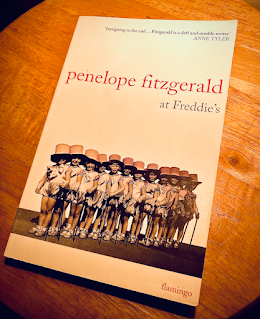
    A very subtle and funny writer - one I've become obsessed with over the past year - in a decidedly Muriel Spark mood. Imagine The Pr...