Thursday, November 09, 2006

Gopnik on Richler

I was all ready to cringe at Adam Gopnik's excerpt on Mordecai Richler in Macleans – so many writer-admirers get Richler wrong simply through being too, well, admiring. Gopnik, however, does an excellent job of mapping out Richler's precise boundaries as a writer, his limitations. (Admittedly, he tends to posit them simultaneously as strengths, which is fair enough, though I don't agree with the assertion that Richler actually outshone his British contemporaries). I was really knocked back by the passage below, because it gets at something I've been struggling to articulate for a while, in terms of what is missing in a lot of contemporary Canadian fiction:
Where the American Jewish novelists were American first of all – "I am an American, Chicago born" is how Augie March greets us – and could lay claim to a whole literature, to Melville and Whitman as much as to their parents' jokes, Richler, like the Australian and Caribbean writers, had first to show that what he was writing about existed at all. He had to show that a language and lore existed before he could attach it to anyone else's tradition.

The satiric, deprecatory tone that he shared with Amis and Braine was therefore allied in his writing to a larger ambition – he had to write about a city (and country) that didn't quite know it was one, about the manners of a tribe who hadn't been told they had them. The urge to inventory a reality that everyone else thought was merely a dependency, one that didn't really count, is present everywhere in his novels, and it creates an unwilled expansiveness, an appetite for setting down experience, that feels less claustrophobic than the worlds of his English contemporaries. It was the same tone, but they were describing a world shrinking inwards. He was describing one pushing out.

So he had to give form to a world before he could make fun of it, and the two ambitions were so closely allied – the affectionate urge to inventory a city and tribe already vanishing as he wrote of them; the satiric urge to mock their narrowness and pretensions – that they became indistinguishable.

(Emphasis mine.)

Giller Chatter vs the code of silence

In lieu of posting the entire discussion here, which would mess up my pretty blog, I have stolen my concluding point from the Giller postmortem now online at Good Reports.

(Also up at The Danforth Review)

Rant ho!

**********

It's not really their fault, but I would be a lot more generous to this jury if there was some effort made to break this code of silence that surrounds the selection process. Booker judges routinely spill the beans on what went on in the meetings, and why certain books got picked and others didn't. I think there needs to be more transparency about the whole thing, not because I think there are conspiracies at work, but because it would be interesting, period, and would genuinely add to the understanding of how writing and publishing and the rest of it works. There is a vested interested in maintaining this illusion that books appear before us and are rewarded through means far too sacred and rarified for us to ever comprehend. For us mere mortals to be told that, say, Vincent Lam's was the book the entire jury could agree on, but was no one's first pick (not saying that was the case, but it's just as likely as any other scenario) would not disillusion us all and send us spiraling into doubt about the worth of awards. And yet, we are supposed to take everything the jury says at face value and believe they picked the absolute "best books."

Imagine if, say, Munro admitted afterward that there was no way she was going to vote for the Windley because it was too Munro-esque? (Again, just a wild theory.)

Instead, we are left to indulge in the silliest CanLit Kremlinology every single year.

Why Canadian publishing people have not yet learned the lesson of publicist-planted gossip and leaked songs as promotion is baffling to me, and just further cements CanLit's reputation as an institution always a few decades behind the times. People love dirt; they get excited about it, and if they get excited about something, they are more likely to see the thing behind it all - books - as something with a bit of life to it.

Is finding out why and how the jury picked the books they did really too much to ask?

Cullen callin'

I will be appearing as a guest/straight man at Sean Cullen's cabaret/talk show at the Drake next Tuesday, the 14th. If all goes according to plan, I will be talking about favourite books, the fascinating role of a review editor, and perhaps even the novel-that-is-too-far-away-to-even-think-about.


Sorry about the title. It usually doesn't come to that.

Wednesday, November 08, 2006

The world cries out for peace (and then lies back and has a little sleep)

Mark December 22nd on your calender, for that is the day of the "Global Orgasm."

I shit you not:
The mission of the Global Orgasm is to effect change in the energy field of the Earth through input of the largest possible surge of human energy. Now that there are two more US fleets heading for the Persian Gulf with anti- submarine equipment that can only be for use against Iran, the time to change Earth's energy is NOW! Read more about the fleet buildup here.

The intent is that the participants concentrate any thoughts during and after orgasm on peace. The combination of high- energy orgasmic energy combined with mindful intention may have a much greater effect than previous mass meditations and prayers.

The goal is to add so much concentrated and high-energy positive input into the energy field of the Earth that it will reduce the current dangerous levels of aggression and violence throughout the world.

Global Orgasm is an experiment open to everyone in the world.

Ok, sounds perfectly reasonable, but how will we know if everyone's doing their, um, bit?
The results will be measured on the worldwide monitor system of the Global Consciousness Project.

Ah, that worldwide monitor system. Well then this can't miss.

Giller shocker!

Random House title wins Giller Prize!

In other news: rain makes things wet.

(Actually, I think a consensus was forming around De Niro's Game as the likely winner.)

At some point very soon, the online panel at Good Reports will continue on with a Giller post-mortem.

Tuesday, November 07, 2006

More tales from the city

(Updated below.)

Following up on the post below, and on the discussion that broke out on Bookninja yesterday, I wanted to quote this, from Northrop Frye’s The Modern Century:
To the modern imagination the city becomes increasingly something hideous and nightmarish.... No longer a community, it seems more like a community turned inside out, with its expressways taking its thousands of self-enclosed nomadic units into a headlong flight into greater solitude, ants in the body of a dying dragon, breathing its polluted air and passing its polluted water. The map still shows us self-contained cities like Hamilton and Toronto, but experience presents us with an urban sprawl which ignores national boundaries and buries a vast area of beautiful and fertile land in a tomb of concrete.

Note that Frye does not go on to say, “so writers should write about something more pleasant.”

If this is your reality, you write about it. The idea that Toronto, or any city, has to measure up to certain standards of beauty or soulfulness before it can be deemed fiction-worthy is absurd.

It is similar to the idea that historical settings are inherently more tempting to a writer because the past is more interesting than the present. As if it were up to reality to make itself interesting enough to catch a writer’s eye. As if fiction were a kind of red-light district, where themes and settings come out to coo and stroke the arms of bored writers.

We do have writers who write about Toronto, as Catherine Bush says on Bookninja, and as gets pointed out in Marchand’s column, and Bush is right that a large part of the problem lies in a lack of critical receptivity, predicated by a lack of real engagement with literature as a living entity. There is too much writing about fiction that positions it as a kind of genteel pursuit, removed from the hustle-bustle and hurly-burly of everyday life as lived by most of us. Writers – even young, so-called experimental writers – are as guilty of this as your average book reviewer.

(And, to be clear, this is not a prescriptive argument – I’m not saying that if you have a Toronto address, you must therefore write about Toronto. The imagination goes where it will. But the prejudice exists, among readers and writers, that Toronto is not interesting enough for fiction.)


[UPDATE: Following up on a point Steven makes in the comments, it baffles me why so many writers would admit to such a failure of imagination.

When a writer says the city has no mythology, all I can think of is, "that's your job."

The dirty little secret, of course, is that genre writers tend to be way out ahead of their literary peers in sniffing out the reality of their city. (Or their times, for that matter.) Mystery, thriller, and sci-fi writers tend to see shifting, unmapped contemporary reality as the artistic challenge it is, and rush out to meet it. Not always elegantly or cleverly or even with any kind of lasting effect, but at the same time, cities and eras often get imaginatively mapped out by the more garish and non-genteel writers within them, Dickens being the supreme example.]

Monday, November 06, 2006

Write about Toronto? Oh please....

Phil Marchand at the Toronto Star has a column up about the peculiar reluctance of Toronto-dwelling writers to embrace it as a setting for their fictions.

It’s an irrefutable fact that most agents and editors prefer novels set in Paris or Moscow or Bombay or Havana or Minsk or anywhere else in the world but Toronto (though you are allowed to have a main character live here or settle here, as long as most of the action is somewhere more exotic). This is simple economics (those books sell) and has nothing to do with literature.

Aside from that, however, the most compelling reason why this happens is given by Barbara Gowdy, who says "You write about where you grew up," and so many Toronto writers did not grow up here. (Hello.) Even that explanation becomes a little thin after a while, however. (I am sneaking up on the place, I swear....)

The most annoying refrain has to be that given by Shyam Selvadurai, Sheila Heti, and John Metcalf in the article, and so many others elsewhere – that Toronto is just not worthy of being written about. It lacks cohesion, a soul, the je ne sais quoi that would make a writer deign to scout it for locations.

“I don't mean to be insulting because you live there,” says Metcalf, “but it's a brutally ugly place."

(Metcalf, it should be pointed out, lives in Ottawa.)

You have to wonder what would it would take to get a writer to drop the perfumed hankie and investigate his own city as a place where real, fiction-worthy human drama takes place. Free wine? Rickshaw rides to the scenes of famous battles? A six-figure contract?

I wasn't around at the turn of the last century, but I'm pretty sure that the Dublin Joyce wrote about obsessively was not exactly a soulful, cultural hotspot in the eyes of the world, or even of its citizens. Neither was Chicago when Bellow started mapping the place out in his novels. (And he wasn’t even born there!)

You would think that living in a large city that was still somewhat unmapped, literary speaking, would be enough to set a writer salivating. That a “brave” writer like Heti can giggle at the very idea of writing about Toronto because “it's not an easily mythologized place" is just pathetic, and just shows how timid and provincial our literary culture is.

Irony is sentenced to death by hanging

from The Guardian:

George Bush described [Saddam's death sentence] as "a milestone in the Iraqi people's efforts to replace the rule of a tyrant with the rule of law."

Thursday, November 02, 2006

Obsolescence watch, part MVXVII

Overheard on the Bathurst streetcar, 8:45 pm:

High school kid #1: "I have a couple of film cameras; I could lend you one."

High school kid #2: "No way! I fucking hate film cameras...."


Film cameras. Somewhere Douglas Coupland is furiously noting something on his special-edition, available-in-Tokyo-only Blackberry.


Speaking of being way behind the curve, technology-wise, I have only just figured out how to make the comments a little more available to all who wish to chastise me. If someone wants to test it out and let me know that everything's ticky-boo, I would appreciate it. Be nice.

It's a dirty job, but they pay clean money for it.

"Gastronomically-eventful?" Well, if the alternative is "gastronomically inert," then I'll take it.

[UPDATE: Michael Bryson has posted the entire Giller discussion on The Danforth Review, as well.]


Speaking of the Gillers, Steven Beattie offers his own take on the discussion at Good Reports, specifically the idea (which I endorse but he doesn't) that this year's shortlist was the result of at least some willfulness on the part of the jury. I agree that you can go too far with it and start sniffing out conspiracies in every corner (see: Henighan, Stephen), but at the same time, there's a whiff of utopianism (and often more than a whiff) about the idea that literary award juries simply pick "the best books they can."

It's the same daisies-and-baby-powder odour that arises whenever a book reviewer says that he reviews books "solely on their own merit." It's simply not true, nor should it be. You don't have to be a raging deconstructionist to understand that art has an artistic, cultural, and social context that informs a person's reception of it. The idea that a jury would massage its picks so that, say, unknown writers are favoured over veterans, isn't one that shocks me to the core any more than does the more frequent Giller practice of using the prize as a career-achievement award.

The only time I start to snarl is when the prize seems to reward the book with the most earnest and important themes contained within. Even then, it's a bit like complaining that big Hollywood movies lack believable characters. Really, what did you expect?

As J.J. Hunsecker would say, "are we kids or what?"

The problem occurs when we look to things like the Giller shortlist to help define "our writing" in any meaningful way. Not surprising, given the near-total lack of appetite for interesting literary criticism in this country (which, by the way, does not mean "more negative reviews!"), where even well-established writers with presumably strong opinions choose to only review books they like (if they write reviews at all), or view literary criticism as an adjunct to their own book's publicity machine, or as a kind of studio audience, there to sigh or applaud at the correct moment. Not surprising, given all that, but nearly useless all the same.

[title quote from here.]

Wednesday, November 01, 2006

Next week: Beetle Bailey has a Vietnam flashback!


(click to enlarge)

The Comics Curmudgeon, from whom I swiped this cartoon, had this to say about it:
I’m really pretty sure that this is the first Holocaust collaboration joke in the history of the comics.

Tuesday, October 31, 2006

Dirty sheets

Though some of Jon Haddock's stuff – like the most recent "Cartoon Violence" series – indulges in a little too much hipster sangfroid for me, his ISP series (porn with the people photoshopped out) is something I've thought about – and brought up in semi-drunken conversations as a perfect illustration of this or that – probably more than is healthy.


Monday, October 30, 2006

Talking 'bout the Giller with Mr Good

I'm part of an online panel over at Good Reports discussing this year's Giller Prize.

Sadly, I will not be attending the big gala next week, so I can pretend to have some integrity about such things for at least one more year. (And possibly many more to come!)


[UPDATE: I've been told that the page can't be read in Firefox, only in Internet Explorer. One option for Firefoxians is to Select All and read it highlighted, or cut and paste the thing into a WORD document. The text is there, it's just hidden.]

Sunday, October 29, 2006

Dahling...

Friday night was the party to celebrate it being ten years since Anne McDermid first hung out her shingle in this country. Despite the venue, with its "let's play at being an exclusive club" vibe, the night was full of warm feelings, helped along by the generously open bar.

Anne, ever the agent, even took a moment to blow some ego-inflating smoke up the ass of one of her nickle-and-dime clients.

I don't believe a word of it, Anne, but I thank you nonetheless. And congratulations.

Friday, October 27, 2006

Thursday, October 26, 2006

Penguin Porn

Many thanks to the unnamed employees of Penguin Canada who allowed me to walk out of their party with Phil Baines’s Penguin By Design: A Cover Story 1935–2005 under my arm.

It is easy to go all fetishistic over covers from Penguin’s classic years, but looking through the book, I’m still baffled as to why more North American publishers and book designers do not follow the clarity-plus-cleverness standard set by some of Penguin’s more famous designs and series. Non-fiction fares a little better, but with literary fiction, there still seems to be a default setting called “averted gaze in sepia.”

Wednesday, October 25, 2006

Who likes short shorts?

Wired has a thing up where writers and celebrities are asked to write six-word stories.

Margaret Atwood's contribution: "Longed for him. Got him. Shit." Which is especially interesting when one considers a contribution from her husband, Graeme Gibson: "Thought I was right. I wasn't."

[mimes cracking a whip]

By the way, no one mentions "veni, vidi, vice" – an epic in three words, with room left for a sequel. (Ba-da-boom! Thanks folks, please tip your waitress....)

The saddest short-short story, one I actually think about a lot, is from Chekhov's Notebooks: "Instead of sheets – dirty tablecloths."

I like this one from the Notebooks, too (if "like" can be taken to mean "makes me squirm with horror ," which is my usual definition of the word): "The ice cream is made of milk in which, as it were, the patients bathed."

There's also this, which maybe hits a little too close to home: "A writer of no talent, who has been writing for a long time, with his air of importance reminds one of a high priest."

Ha ha ha, that's so, hmm... fuck off.

Tuesday, October 24, 2006

Beyond the reach of satire

from CNN.com:
OKLAHOMA CITY, Oklahoma (AP) -- A candidate for state superintendent of schools said Thursday he wants thick used textbooks placed under every student's desk so they can use them for self-defense during school shootings.

"People might think it's kind of weird, crazy," said Republican Bill Crozier of Union City, Oklahoma, a teacher and former Air Force security officer. "It is a practical thing; it's something you can do. It might be a way to deflect those bullets until police go there."

Crozier and a group of aides produced a 10-minute video Tuesday in which they shoot math, language and telephone books with a variety of weapons, including an AK-47 assault rifle and a 9mm pistol. The rifle bullet penetrated two books, including a calculus textbook, but the pistol bullet was stopped by a single book[....]

Thoughts from the IFOA

Eden Robinson has the loudest and most easily triggered laugh in all of Canadian literature. She'd make an excellent audience member at the live taping of a comedy show – with her in the front row, even the Air Farce would sound as though it were going over like gangbusters.


If you haven't already read Robinson's excellent first book, Traplines, please do so. And then read Blood Sports, a novel-length sequel to one of the stories from Traplines.

For the curious, you can read my review of Blood Sports here.

Monday, October 23, 2006

The boards and the borders

At my work, I still get all of the email intended for my predecessor. The most frequent emails I get are updates from the Centaur Theatre in Toronto and from The Minuteman Project, those jolly border-watchers from down south.

It’s an odd juxtaposition, but it gels perfectly with my own perception of James as a theatre-loving xenophobe.

I kid, I kid....

Two ways to take a joke

Like old money:
For a certain kind of person, satire is just another little party thrown in your honour – Henry Alford

or like new:
New York is all about publicity, and everything that isn't puffery is looked at as assassination. – Walter Kirn

[both quotes are taken from SPY: The Funny Years, by Kurt Anderson, Graydon Carter, and George Kalogerakis]

Friday, October 20, 2006

And meeting Trudeau got Lennon shot

from The Calgary Sun:
Fisheries Minister Loyola Hearn says he and Newfoundland Premier Danny Williams helped take the shine off [McCartney's] romance with Heather Mills.

He pointed to McCartney's appearance last spring on the Larry King Live Show.

Hearn said McCartney appeared to appreciate the points Williams made, while his wife -- a vocal animal-rights activist – was "not so gracious."

We Canadians, as a people, are geniuses in the art of embarrassing the fuck out of ourselves.

Bravo. Bra-fucking-vo.

"We're actors, not figments of your imagination!"

Terry Gilliam’s Tideland is getting some fairly harsh reviews so far, blasting it as a series of self-conciously “weird” visual images anchored in very little narrative. It’s hard to tell if the critics are right, based on the movie’s trailer, which is a series of self-conciously “weird” visual images anchored in very little narrative. But that may end up being a very, very good thing.

I haven’t really expected much of Gilliam lately. Twelve Monkeys was fun to watch, but was far from the subversive mainstream mind-fuck it is occasionally hailed as. Fear and Loathing in Las Vegas was like two interesting movies playing simultaneously – one a clever and breezy goof on Hunter S. Thompson by Johnny Depp, the other a volcanic lesson in real character acting by Benecio Del Toro. Plus Gilliam never set a consistent visual tone, which is strange for a former animator known for the look of his movies. Aside from the inevitable freaky-deaky, psycho-fornia set pieces, a lot of the incidental scenes seemed shot by an assistant director on loan from some hack Toronto-shot SF series.

The Brothers Grimm was one of those works that contain all of the most obvious things you liked about an artist, but seems to use them only in a desperate attempt to distract from a hollow core. The kind of thing that makes you start wondering if the earlier works you loved so much were all that good to begin with. This is known as a “Rushdie.” Or maybe a "Costello.”

And yet, I'll probably go see Tideland. If it's a mess, it'll be an interesting one.

CSIS to Muslims: Use Telepathy!

Matthew Behrens of the Campaign to Stop Secret Trials, part of the work done by Homes Not Bombs, writes a letter to The Toronto Star concerning the recent decision not to deport Mahmoud Jaballah to Egypt. Jaballah is one of the men Behrens and many others (including Alexandre Trudeau and James Loney) are working to either free or be made subject to a fair and open trial.

Matthew's letter, in its entirety (or read it here, while the link is active):
Allow him to stay here , Oct. 19.

I welcome the decision not to deport Mahmoud Jaballah to torture in Egypt, but it's unfair to declare he should eventually be removed from Canada. I have known Jaballah and his family for more than five years and he does not in any way resemble the scary individual outlined in bare-bones CSIS allegations.

The Federal Court upheld a security certificate against Jaballah largely based on secret "evidence" that neither Jaballah nor his lawyers can see or cross-examine. There is no appeal of the decision, and no charge is ever laid.

The standards of "proof" are the lowest of any court in Canada ("reasonable grounds to believe" certain things may be true) and the legislation specifically states that anything not normally admissable in a court of law can be entered in one of these proceedings. In other words, we are no longer in a court of law.

And so it was that straight-faced government lawyers recently named Jaballah a "communications relay expert" because he wasted no time in getting a phone hooked up in his first apartment, borrowed a cellphone to stay in touch with his pregnant wife, "procured" a fax machine and surfed the Internet. If that's the basis for suspicion, Canada's 600,000-plus Muslims should, in an abundance of caution, revert to smoke signals or train in telepathy to stay in touch with family and friends.

This is the same Jaballah who was found to be credible and had a prior certificate against him thrown out in 1999. Two years later, he was re-arrested and CSIS admitted in the open portion of the secret hearing that it had no new evidence against him, only a "new interpretation" of old evidence that was previously dismissed.

If the allegations against Jaballah had any factual basis, why hasn't he been sought by the U.S. or Britain to face charges? The U.S. is not shy about rounding up people, even if the case against them is weak.

Most frightening, in light of the Maher Arar inquiry, is the heavy reliance in these cases on Canadian "intelligence" agents who have little or no training and base their cases on recycled newspaper articles. As the Star reported during Jaballah's recent bail hearing, a high-level CSIS official was "too busy" to read the 9/11 Commission report on intelligence failures, including those sections that dealt with Canada. The officer also refused to confirm that torture takes place in Syria and Egypt, even after the finding that such horrid acts are systematic by Justice Dennis O'Connor of the Arar Inquiry.

Until we return to court-of-law standards with respect to any "national security'' allegations, it is grossly unfair for the Toronto Star to draw such drastic conclusions about Jaballah or anyone else subject to this medieval process.

Matthew Behrens, Toronto

Read more here.

Thursday, October 19, 2006

The Aragorn Doctrine

from Salon:

In an interview with the editorial board of the Bucks County Courier Times, embattled Pennsylvania Sen. Rick Santorum has equated the war in Iraq with J.R.R. Tolkien's Lord of the Rings. According to the paper, Santorum said that the United States has avoided terrorist attacks at home over the past five years because the "Eye of Mordor" has been focused on Iraq instead.

"As the hobbits are going up Mount Doom, the Eye of Mordor is being drawn somewhere else," Santorum said. "It's being drawn to Iraq and it's not being drawn to the U.S. You know what? I want to keep it on Iraq. I don't want the Eye to come back here to the United States."

That's at least a little more imaginative than the "Practice Makes Perfect" Doctrine offered by Christopher Hitchens:
How are we going to learn – how are we going to learn how to fight these people in rogue states and failed states if we don‘t – which are bad conditions, if we don‘t try?

Hmm, that's pretty bad, but you're up against Mordor here, Mr Hitchens – can you try for something a little stupider?
If we‘re going to pay—if we‘re going to pay for this huge military establishment, then I think...

Ah, the "Use It or Lose It" Doctrine. Close enough.

Wednesday, October 18, 2006

The Cute One

from The Star:
Allegations made in leaked divorce court documents that Sir Paul McCartney abused his now estranged wife are untrue, says the former Beatle.
[...]
In the document, Heather Mills McCartney alleges that Sir Paul attacked her four times. During one incident, she alleges that McCartney poured a bottle of wine on her head during an argument, then threw the wine still left in his glass into her face, broke her glass and stabbed her in the arm with the broken stem. She also alleges that on separate occasions McCartney shoved her, sending her flying over a coffee table, grabbed her around the throat and pushed her into a bath while she was pregnant.

She also alleges that McCartney drank heavily and used illegal drugs, despite promises to curb the habit, that he called her an “ungrateful bitch,” prevented her from breastfeeding, saying “They are my breasts,” and made her cancel a crucial operation because it got in the way of his vacation
.


You'd think that people
Would have had enough
Of silly love songs
I look around me and I see it isn't so
Some people wanna fill the world
With silly love songs
And what's wrong with that?
I'd like to know
'cause here I go again
I love you, I love you

¡Aye Carumba!

Brad R. at Sadly No! says "Wow" – to which I can only add... Wow.

Just watch it.


[I especially like the white father who tries to get his eight-year-old daughter a job, only to be disapointed by the Bi-Lingual Only! sign]

Monday, October 16, 2006

The Globe's ALT snark

Gary C. has discovered something very odd about the ALT tags – "a piece of optional code that is attached to an image, providing a textual description of the photo or graphic" – accompanying a piece about a Paris fashion show on the Globe and Mail's website.
It seems that a Globe web programmer decided to do a bit of editorializing in these seemingly invisible ALT tags. Hidden in the source code of a Chanel photo (pictured) is the comment, "Is getting your sweatshirt stuck halfway over your head the new look? Because I can totally pull that one off."

Other photos include text such as "Fashion models know all too well the pain of the wedgie" and "Apparently, throwing on your husband/father's white shirt is now high fashion." One image that shows a model's nipple is accompanied with the text, "Is it chilly in here, or is it just me?"


Read the whole thing here.

Call the tech guy – the Reviewtron 3000 is on the fritz again...

Can somebody please explain what this means? (From Michelle Berry's review of Adam Lewis Schroeder's new novel in the past Saturday's Globe):
Harry is funny and mean and intelligent and dumb and tender. In 1942, he is a strong-willed sailor with a deep love of jazz, then, in the camps, he is light-headed from hunger and has lost his eyesight from beriberi.

So, he's not only intelligent and dumb, but funny, mean, tender, strong-willed, jazz-loving, light-headed, and blind as well?

Or this?:

Harry's 1995 travels in Thailand, at the end of the book, take on a surreal feel as he stumbles through his past and confronts people he didn't know existed. This is a scattered first-person narrative that is brilliantly written. With dry wit and intense emotional longing, Harry moves the reader around his world, his past, the war and what happened to men and women back then. Memory comes in fragments. Even if it is linear and presented chronologically, memory scatters and moves around with emotion.

Memory moves around with emotion, in scattered fragments that are linear and chronological?

Cornball Leafs

In Saturday's Toronto-Calgary game, Darcy Tucker, usually to be counted on to go bug-eyed and fighty at a dishonourable check or a bad penalty call, seemed unusually sanguine about being called for hooking in the last ten seconds of the game, putting the Leafs on the penalty kill going into overtime.

The penalty was questionable at best, so where was the Pacino-esque scenery-chewing?

Of course, less than a minute later Mats Sundin netted his 500th career goal. Unassisted. From about thirty feet out. And it was the game winner. In overtime. Short handed.

I made a joke afterwards that Tucker took the penalty well because he knew the fix was in – he heard the swelling strings, and could see that his team was about to pull off one of those ultra-cornball moments of melodrama, where, the odds stacked against them, the true-hearted Buds pull off a miracle with the help of grit, determination, and – yes – just a little luck.

Ha ha, right?

Then I read this, in today's Toronto Star (scroll down):

TUCKER PSYCHIC? Darcy Tucker had an odd sense of peace when he was sent off the ice for hooking with just eight seconds remaining in Saturday's game, even though the game was tied 4-4 and appeared headed for overtime.

"I had a funny feeling when I was in the box that something good was going to happen. I don't know, maybe you get calmer as you get older, but I was pretty calm in there. I just had this feeling that something good was about to happen," he said.

That something good was Mats Sundin scoring the winning goal, shorthanded in OT.
[Emphasis mine.]

Cue the dying child: "Score me a – kaff, kaff – overtime winner tonight, please, Mr Sundin..."

Friday, October 13, 2006

Frazier has left the building

It's not like I was likely to read Charles Frazier's new book, Thirteen Moonshistorical fiction not being my thing – but now that I've read Stephen Metcalf's review at Slate.com, I may start crossing the street when I see someone carrying it:
Sacred water, huckleberry juice, wolf teats—Thirteen Moons, you may have guessed, is a catalog of faux naive Americana. Much of the book is written in a "ye olde" diction: People go "a-roving," and get "a-plenty of oats," and "travel retrograde to [their] anger," whatever that means. It's a yokely-dokely pastiche, of Faulkner (by way of Toni Morrison) and of the King James Bible (by way of Jack Handy), and it is to the actual American idiom, past or present, roughly what the Rainforest Café is to the Amazon basin. The aim is as follows: to indict the modern way of life, in tones of noble pathos, and at precisely zero cost to the modern reader's self-esteem. Great care is taken to ensure that huckleberry juice goes down nicely with that mochachino you're enjoying. Consider Frazier's talents for flattering multiple constituencies. Even as he extols the simple piety of the unlettered heart—a reverence for Native American illiteracy is announced no less than three times in the first 60 pages—the author winks maniacally to his old English-major friends, giving Will a horse named Waverly and throwing in showy namechecks, from Horace to Rousseau to Byron.

Many books are manipulative, of course, and a great many are trash, and a very sorry many of these become best sellers. And yet only a precious few reach the level of bad faith attained by Thirteen Moons.

It just gets better, pointing out something that routinely dooms these kinds of books:
The intuition that capitalism has robbed human beings of something essential has been a staple of art and thought since the advent of modern life, and it has been measured by writers as different in purpose and temperament as William Cobbett and T.S. Eliot. But what they never suggested was that hidden beneath the old rural folkways, the old courtesies, and the observances of traditional belief, lay all the liberties of interpersonal freedom. Strip them of their old-style hats and stilted speech, Frazier would have us believe, and our forefathers and mothers (the good ones, at least) were just like us: free, spontaneous individuals, life-affirming figures straight off a highway cigarette billboard. That the pose of sexy spontaneity Will and Claire enjoy with each other, it could be argued, is itself a product of modern life—of the factory and the wage system, of national markets and advertising, of the appurtenances, dreadful and otherwise, that swept away the quasi-aristocracy of the Old South—well, this never seems to perturb Frazier. The ahistorical conscience gets quite the workout in Thirteen Moons.


Ah! it is made bright, it is wrapped up for the slaughter.
- Ezekiel, 21:15

Thursday, October 12, 2006

Amis fils

My god, Martin Amis is a self-righteous, hypocritical, intellectually lazy prick*:
"When I come back to Britain I see a pretty good multicultural society.... The only element that is not fitting in is Islam. Who else isn't fitting in?"

Aside from the fact that Islam is a religion, and therefore not a “who” (we call them “Muslims,” Mart), I’m pretty sure you could, were you to scour the English countryside, find a few other groups who don’t “fit in.”

I also liked this:
[Amis] also admitted having experienced a moment of "sanitary racism" on a recent long-haul flight.

"It was quite unsettling," he said. "I was sitting on an aeroplane with 349 Chinese, and it's really quite disturbing the way it comes round. You see them getting up or going to the toilet and you catch yourself thinking 'there goes another one'."

Chinese? Chinese?

Sounds an awful lot like Amis’s father, Kingsley, describing for his scandalized son how it feels to be a “mild” anti-Semite:
"Well, when I'm watching the credits roll at the end of a TV program, I say to myself: 'Oh, there's another one.'"

Except that where Kingsley’s admission is honest, sad, and human, Martin inadvertantly reveals – as if the evidence of his recent novels was not enough – just how little he knows his own mind, never mind his grasp on human nature in general. This is why I never trust writers like Amis – self-consciously modern and rational and sensitized – when they write about racism or sexism or classism: they believe themselves to have evolved beyond what are basic, if unpleasant, human responses. When these responses inevitably become more insistent (it's called getting old), writers like Amis assume they must be new, and therefore somehow more legitimate and noteworthy than the boorish opinions of their elders. A writer like Kingsley knew he was a pig – born and bred – and never fooled himself into thinking his own sexism and racism was somehow different from or more nuanced than that of his father or his father’s father. Martin, on the other hand, is the type who would write a 3000-word essay for The Guardian because he got an erection at a strip club. ("And yet, her sad, spasmodic gyrations had a curious and unexpected effect on me...")

Also, though Kingsley got fat and old and lazy and gave in to toxic bigotry, he was still able to write a book like The Old Devils. At this rate, Martin will be lucky if he writes another Dead Babies.

Seriously:
In the slave labour camps of the Soviet Union, conjugal visits were a common occurrence. Valiant women would travel vast distances, over weeks and months, in the hope of spending just one night with their lovers in the so-called House of Meetings. Unsurprisingly, the results of these visits were almost invariably tragic.

Martin Amis’s new novel, The House of Meetings, is about one such visit; it is a love story, gothic in timbre and triangular in shape. Two brothers fall in love with the same woman, a nineteen-year-old Jewish girl, in 1946 Moscow, a city poised for pogrom in the gap between war and the death of Stalin. The brothers are arrested, and their fraternal conflict then marinates over the course of a decade in a slave labour camp above the Arctic Circle. The destinies of all three lovers remain unresolved until 1982; but for the sole survivor, the reverberations continue into the next century.


About the only thing in that description that is even mildly interesting is the fact that the book will be “triangular in shape.” When did Amis become a middlebrow Canadian novelist, raiding someone else’s history for thematic padding?

Sad, if not entirely unexpected.


* I freely admit that this description applies to the author of this blog as well. I will also admit there are many, many sentences and paragraphs in Amis's novels that I'd kill to have written – though not so many of the novels themselves.

Wednesday, October 11, 2006

New Jay-Z

Pitchfork says meh, Graham says yeah, but until I actually hear it, I'm going to split the difference with a myeah.

A much as I want Graham's take – "The beat is ridiculous both in the sense of its overwhelming dopeness and the expectations that would seem to be built into it... [Jay's] flow continues to be miles ahead of anyone else working today in the mainstream (and probably the underground...)" – to be right, and as much as one should always mistrust Pitchfork, especially when it comes to hip hop, this sounds all too plausible:
The stubborn Hov-apologist side of my brain wants to inflame lame excuses. It's better than "Change Clothes"! It's not easy to flow over this shit! [...] But, really, we've been waiting two years for this. There's no excuse. "No two alike like a snowflake," he says, obviously not referring to his own lyrical output. With few B.I.G. lines left to plunder, Jay recklessly reverts to his own past. Seasonal updates. Gold bottles. "The king's back!" And, of course, the Jordan obsession, which is getting creepier (and lazier) by the verse.

[UPDATE: Listened to the track a couple of times last night, and I’m going to have to go with Pitchfork for this one. The beat is interesting – maybe a little too interesting: these self-hyping, horn-heavy “events in sound” get tired fast. But the fault really lies with Jay – at his best, the man can ride a beat as if there’s only half the earth’s gravity in the vocal booth, and he clicks here a lot during the verses, but mostly it sounds like he did it all in one take at the end of a long day. The beat just keeps getting away from him.]

Editorial cartoons for the slow row

Allow me an Andy Rooney moment:

An editorial cartoon is a single, easily parsed opinion (more often the conventional wisdom and not that of the cartoonist himself) on a recent event or headline, distilled into cartoon form, agreed? Agreed. By definition, it is fairly easy to work out what the cartoon is saying, yes? One needn't spend a few minutes on, say, a cariacature of George Bush at the wheel of a broken-down car that says "US economy" on the door, or of Stephen Harper handing a big bag marked "$" to fat men in pin-stripe suits, right?

So why, when the Toronto Star reprints editorial cartoons from Quebec papers, which it takes the time to translate into English, does it then take the absurd step of having the cartoonist briefly explain what it was he was trying to put forth in the cartoon?

An example: this past Saturday, the cartoon, by Serge Chapleau of La Press, was titled "Ignatieff Recognizes Quebec as a Nation." In it, a jowly looking Michael Ignatieff is saying, "And if I open this door..." and is about to stick a big key into a little door marked "Constitution." The anthropomorphized doorknob yells back at him: "No! No! No!"

Get it?

Here, I'll describe it again:

A little door marked "Constitution."

Ignatieff: "And if I open this door..."

Doorknob: "No! No! No!"


Apparently this is like string theory for readers of the Star, so Chapleau offers this helpful explanation:
In this cartoon, I tried to show the sentiment in many parts of Quebec that it would be a bad idea for Liberal leadership candidate Michael Ignatieff to open the Constitution to enshrine in it Quebec's status as a nation, as he said he would like to do.

What, no explanation for the talking doorknob? Why is Ignatieff's head so abnormally huge and his features grossly exaggerated? Why is speech represented by a little, white cartoon containing actual text? How are these characters able to speak at all when they are, in fact, TWO-DIMENSIONAL REPRESENTATIONS IN INK????

Tuesday, October 10, 2006

Here comes the Sun

This morning I bought the Toronto Sun – with my own money – for the first time in my life, entirely on the strength of the cover. I think I walked by it three times before finally conceding defeat and digging out some quarters while giggling like a schoolgirl.

Here's the Sun's wise, informed, and nuanced take on North Korea's nuclear sabre-rattling:


This isn't quite up to the level of their post-9/11 cover, which was just a picture of the exploding WTC and the word "BASTARDS!", but it's close.

I also think it would have worked better to put "SCARIER" in a creepy-looking, italicized typeface, a la Count Floyd.

Friday, October 06, 2006

Snuff puppies


"In Fallujah, dogs survived by eating bodies of insurgents that we killed. You can see why some animals had to be put down. If you are lying there sleeping, you look like a dead person."

- Jay Kopelman, author of From Baghdad With Love (interviewed here)

That cover doesn't really say "Iraq War" to me. I think they should have gone with something more along the lines of this:

Beat down

Craig Davidson launch was much fun. Yes, it was a big publicity stunt, but all four fighters went at it with honour. The card girls were a strange touch, though authentic, I guess. The decision to stick an interview between the fights was a potential mood-killer, but it went by mercifully quick.

Read an account from Torontist.com here.

One of my more notable memories of the evening was sharing a can of beer with Anne McDermid, whom I'd snuck into the media area.

Thursday, October 05, 2006

The wet paper bag


Because of tonight's book launch/ boxing match, there has been a lot of talk in the office about fighting – who has done it and who has not.

I'm always shocked to discover how few people I know have even thrown a punch since their childhood. It's similar to the shock I feel when I find out how many people have never worked in a bar or restaurant, something I always assumed was pretty much universal. I'm no brawler, so I always assume the very low number of altercations I've been in since high school should stand as a kind of absolute minimum.

And then I came across this, from Slate's paraphrased excerpts from Bob Woodward's new book about the decision to invade Iraq:
Page 143: In the run-up to the Iraq war, [Colin] Powell notes that Bush, Cheney, Rumsfeld, and Rice have never seen combat. "You know," Powell says. "the problem with these guys is they've never been in a bar fight."

Some variation of that quote, with varying degress of literalness, is always running through my mind when I'm at a book event. Boxing match or no, it'll be running through there tonight, too.

Harpo

Having waited too long to make up my mind whether or not to go, I missed last night's sold out show by Joanna Newsom at the Mod Club. Instead, I watched the first period of a hockey game in which both teams looked hungover, then gave up and tried to do some writing when it seemed sure the whole thing was shuffling toward its completely predictable result.

Dan D. gave me a copy of Newsom's first album last year, and it has been growing on me ever since. Even those members of my household who have a violent allergic reaction to kind of thing she is trying to do – her voice alone makes Cyndi Lauper sound like John Houseman in comparison – will admit it is strangely compelling, and will even allow it to remain playing for more than one song.

There is still a half-minute or so, every time I put it on, where I have to force myself to get over the impression that I am listening to the musical equivalent of a Sheila Heti story.

On the other hand, the fact that her new album will have the fingerprints of Van Dyke Parks, Jim O'Rourke, and Steve Albini on it is reason enough for me to go pick it up. It'll be like the Ocean's 11 of harp-based, faux-naif non-rock.

Wednesday, October 04, 2006

Reading the tea Leafs

Damien Cox has a column in the Star today about the Leafs chances for going all the way this year. (If you know Cox, or the Leafs for that matter, you know that answer is "not good.")

Cox notes that new head coach Paul Maurice was born in 1967, the year the Leafs last won the Stanley Cup.

I just know there are a few thousand guys in blue-and-white jerseys furiously trying to determine whether this is a sign of hope or a harbinger of doom: "Do I add up all the players' birth dates, or just the ones on the active roster?"

I swear to God, Leafs fans are worse than the son in the mental institution in Nabokov's "Signs and Symbols":

Phenomenal nature shadows him wherever he goes. Clouds in the staring sky transmit to one another, by means of slow signs, incredibly detailed information regarding him. His inmost thoughts are discussed at nightfall, in manual alphabet, by darkly gesticulating trees. Pebbles or stains or sun flecks form patterns representing in some awful way messages which he must intercept. Everything is a cipher and of everything he is the theme.


James G. says the Leafs will win tonight 3-2. (But then, he would, wouldn't he?) I predict they don't find their legs until late October or November.

Tuesday, October 03, 2006

If Gillers were horses...

I wasn't even close.


Finalists for the 2006 Giller Prize:

* Rawi Hage for his novel De Niro’s Game, published by House of Anansi Press
* Vincent Lam for his short story collection, Bloodletting & Miraculous Cures, published by Doubleday Canada
* Pascale Quiviger for her novel The Perfect Circle, translation by Sheila Fischman, published by Cormorant Books
* Gaétan Soucy for his novel The Immaculate Conception, translation by Lazer Lederhendler, published by House of Anansi Press
* Carol Windley for her short story collection, Home Schooling, published by Cormorant Books


Four out of five are small press; two books in translation; two short story collections; no big names – why do I get the feeling that this year's Giller jury has just become the equivalent of Kurtz in the eyes of much of the Canadian publishing industry?

"The shortlist. You're looking at the shortlist. Sometimes they go too far. They're the first ones to admit it."


[UPDATE: I just did an interview with CBC-TV about the shortlist – no idea how it will look once they finish editing me into articulacy, but right now I'm thinking I should stick to ham radio and semaphore.]

I may be burning bridges, but I'm teaching the world to singe


In the past month or so, this site has been visited by people from Norway, the Netherlands, Hong Kong, Australia, Thailand, Switzerland, the UK, Ghana, and more, as well as a few hundred each from the US and Canada.

And not one of those visits was the result of a mistake made while googling for porn.

Truly, the yearning for impotent rants against irretrievably minor Canadian celebrities is a universal one.


Smile on your brother.

Monday, October 02, 2006

March of the Penguins


Gary C. sent me a link to this collection of old Penguin and Pelican paperback covers.

This is porn for people who have spent much of their lives in used book stores. I once made instant friends with a guy from Scotland, based entirely on the fact that he was wearing an old-style Penguin logo T-shirt. (Don't read too much into that.)

I still buy those crappy orange Penguin paperbacks – it's worth the darkening paper, the small type, and the psoriatic crumbling of the spine glue just to get a book for less than three dollars.

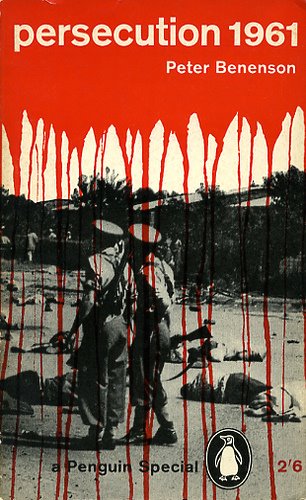
[The cover above reminds of something Sam Raimi said about the making of Evil Dead: one of their financial backers – probably some local used car-dealer or something – wanted the boys to "make the screen run with blood," so they obliged by having a scene in which they actually threw a bucket of fake blood at the camera's lens.]

The Importance of Being an Asshole

from Alicublog, some thoughts I fully endorse:

... but one is forced to admit that the critic has a point, and if we honestly disagree we must, at least in our own minds, answer it. Sometimes harsh criticism provides shocks that are not just tittilating, but salutary as well: they force the mind to encounter a contradictory point of view (as with, say, Christopher Hitchens on Mother Teresa). There is much to recommend the more patient and polite kind of criticism, but when attitudes have hardened, the discussion can always use a swift kick in the ass.

Friday, September 29, 2006

More Steyn

Glenn Greenwald has a post up today about Mark Steyn. Steyn and Hugh Hewitt have a lot of sidesplitting things to say about all those dark, dangerous men being held in Gitmo, and the "lavish" conditions in which they are kept. (All of this on the day the US Senate voted to authorize torture.)

Here's Greenwald:
These two coddled authoritarian cultists are giggling about people who have been put into cages for the last five years on an island, away from their lives and their families, with little hope of ever being released. Many of them have attempted suicide. Actual terrorists ought to be detained and sentenced to life in prison or, reasonable people can believe, executed, provided they are found guilty in a fair proceeding. But large numbers of these detainees have been imprisoned without ever being charged with, let alone convicted of anything. And it is beyond dispute -- even the Bush administration admits -- that many of those we have detained in Guantanamo have been guilty of absolutely nothing.

To sit around chortling about how great these detainees have it and how grateful they should be requires a sociopathic derangement that is nothing short of grotesque. And to believe that people on a one-day controlled visit get an accurate or complete picture of what goes on there requires a blind faith in the Government so absolute that it is explains most of what one needs to know about the authoritarian Bush movement. On the day our country legalized tortured techniques and vested the definitively un-American power of indefinite detention in the President, Hugh Hewitt and Mark Steyn take off their masks and reveal the hideous and frivolous face of the Bush follower.

By the way, as James Wolcott has noted helpfully, "Steyn" rhymes with "whine," not "stain," though really, both would be perfectly appropriate.

More Steynishness here.

Thursday, September 28, 2006

"Peculiar touchiness"

Mark Steyn, the man who once wrote that "these days, whenever something goofy turns up on the news, chances are it involves a fellow called Mohammed," brings all of his wisdom, delicacy, and insight to America's racial divide in his latest column for Macleans.

The column, entitled "Keepin' it real is real stupid" (always encouraging when a headline in a national magazine just barely reaches the level of a pamphlet about peer pressure handed out in high school), is ostensibly about a new book by Juan Williams's new book, Enough: The Phony Leaders, Dead-End Movements, and Culture of Failure That Are Undermining Black America - And What We Can Do About It.

Here's how Steyn sees the black-white divide these days:

Whatever good it might once have done, America's racial-grievance industry is now principally invested in its own indispensability. Lavishly remunerated panjandrums such as the Reverends Jesse Jackson and Al Sharpton have a far greater interest in maintaining racism than any humdrum Ku Klux Klan kleagle, assuming there still are any.


Jesse Jackson: more racist than the Klan (if such a thing even exists anymore).

Here's Steyn on the destruction of New Orleans:

Most Americans looked at what was happening in New Orleans and concluded that it's a great place to enjoy a margarita with a topless transsexual Mardi Gras queen, but you wouldn't want to live there: a deeply dysfunctional city exclusively controlled by Democrats for generations, it's a welfare swamp with a lucrative tourist quarter.

And America's better off without it!
The concept of "authenticity" -- that one's skin colour mandates particular behaviours, such as voting Democrat and supporting "affirmative action" -- is, of course, racist. But the peculiar touchiness of the black community on this question recurs again and again in Williams's book.

"Peculiar touchiness." Hmm. You don't thing a history of slavery, lynching, segregation, and systematic racism would have anything to do with it, would you? "We recultantly gave you some of your basic civil rights after decades of fighting you tooth and nail – what are you so touchy about?" You don't imagine Steyn has heard anything about those naughty little voter disenfranchisement schemes that seem to keep popping up every time there's an election in he U.S.?

Of course, we can't talk about race in America without talking about hip hop:
This is a fascinating theme whose significance extends far beyond music -- or, in this case, 'music.'

I can check, but I'm pretty sure putting quotation marks around "music" when referring to hip hop or rap went out of style some time in the late nineties. Speaking of music, here's what Steyn, the theatre columnist for the New Criterion, once said about a recent production of A Chorus Line, in which the cast was all done up in 1970's-era haircuts and clothes: "It shows how hip I am, it doesn’t look years out of date to me."
Williams recalls that in 1956 'a gang of white men dragged the famous black singer Nat 'King' Cole off a stage and beat him because they said he was singing love songs to white women.' They weren't wrong about that: my mom loved him.

And she always would remember that handsome nigger's dazzling smile as those boys kicked him in the head. What a dreamboat.

Here's my favourite bit of the whole column:

A few years back, arguing for the teaching of "Ebonics" as a distinct language, professor Ron Emmons of Los Angeles City College produced a list of black America's contributions to the English language: hip, cool, gig, jiving around, get high, gimme five, hot, baby, mojo, fine, mess with, thang (as in "doin' my," he helpfully explained), take it easy, slick, rip-off, bad . . . Hmm. Does that list really testify to the vitality of "Black English"? By comparison, India via the Raj gave English (to pluck at random) pajamas, bungalow, jodhpurs, cheroot, cummerbund, veranda, khakis, karma. Despite the best efforts of the late Tupac and the Rodney King rioters to copyright them, even "thug" and "looter" come from the subcontinent. Doesn't that list make "jiving around" and "get high" look a bit weedy?

Steyn: the wogs we colonized gave us niftier words than the darkies we enslaved. Case closed.

I should point out that Steyn and I are both Canadian, and Canada has given precisely jack-shit to the world in terms of new words. Who looks "a bit weedy" now?

I should also reiterate that this column was published in Macleans, the magazine I recently heard Noah Richler praise for its having moved from the dentists' offices of the nation into our front rooms. That's Canada: all jodhpurs, no mojo.

Bit of a rip-off, though.


[UPDATE: I know full well that Steyn writes these kinds of things to get liberals all enraged, out of a pathetic and juvenile need for attention and negative validation, Ann Coulter-style, but still, sometimes it's nice to be reminded that you can say whatever you like in this country as long as you've reached D-grade celebrity status in the U.S.]

Wednesday, September 27, 2006

Trimming the fat

This:

The opposition hurled their best you're-so-insensitive insults at the Conservative government Tuesday in the aftermath of $1 billion in cuts to programs.

But that outrage is probably confined to the usual Tory critics, say observers. Conservative supporters, meanwhile, will embrace the "fat trimming."


And this:

Despite the political outcry, many Canadians will accept the argument that the government needs to chip away at spending in the name of efficiency and prudence, said pollster Frank Graves.

"Not too many of the 905 folks are going to be up late gnashing their teeth" over some of these cuts, said Graves, president of EKOS Research.


And this:

Imagine that. The Conservative government we elected in Ottawa eight months ago is starting to get, well, conservative.

We've been waiting for Prime Minister Stephen Harper and his crew to show us they're significantly different from the Liberal gang they booted out of office in January.


And this:

SALARINO

Why, I am sure, if he forfeit, thou wilt not take
his flesh: what's that good for?

SHYLOCK

To bait fish withal: if it will feed nothing else,
it will feed my revenge.

Tuesday, September 26, 2006

Scorchers

I just recently bought Soul Jazz’s Studio One Scorchers Volume 2, and while it isn’t quite the party-in-a-can that was Volume 1 (which never seems to get more than half-a-foot away from my CD player), it works as a kind of CD-length B-side to that record. More of the same, though a lot less instantly addictive.

Bark à la lune


Of all the fantasies indulged in by Kimveer Gill, the one that should have set off warning bells was his apparent belief that Ozzy still ruled.

All his other delusions flowed from that one, I'm guessing.


What, that's crazier than blaming his murderous rampage – at an English-language school – on the fact that he wasn't pure laine?

[NOTE: if that link doesn't work go here to get the gist.]

Monday, September 25, 2006

"Always aim for the turban, Jimmy."


Check out the photo Macleans had on its homepage as of about an hour ago. (They've changed it.)

Pack your kit, show your grit, talk bullshit

Neil Kitson takes a nicely aimed shot at the King and Country crowd at the Globe on Antiwar.com:


Bloody but Unbowed: Canadians in Afghanistan
From the editorial board of
The Globe and Mail


"Canadian troops are not in Iraq, although this newspaper has consistently advocated sending them there. As we said at the time of the Coalition intervention in 2003, 'much good should flow from it.' Subsequent events have proved our position to be entirely wrong. It is now clear that Iraq is in a much more desperate situation than before the invasion, that there were no 'weapons of mass destruction,' and that the invasion was illegal and without justification. We at the Globe are therefore satisfied, like Col. Cathcart, that our genius for ineptitude has not been blunted.

It is in this light that we wholeheartedly support the Canadian involvement in the Afghan catastrophe. We report that our troops are being killed and injured at quite respectable rates, enough perhaps to get us some credibility in Washington. It is indeed regrettable that some of these casualties have been from American bombing and strafing, but this is still honorable: war is a tough business...."


Read the whole thing here.

Friday, September 22, 2006

Snappy answers to troubling questions

SCENE: : outside Lansdowne Station, 1:30 am


WOMAN: (looking lost) Do you know what 666 is?

ME: The number of the beast.

WOMAN: (looks up and down street) That's what I'm looking for!


Exeunt.

Monday, September 18, 2006

Don't Look Bock

In the Globe today, Dennis Bock was asked about "criticisms of current Canadian literature for its continued reliance on historical settings."

His reply:

"It's a ridiculous issue. You hear it from people who don't have the capacity to write outside their own experience. There is no Dennis Bock in this novel. For me, it's interesting because it has nothing to do with me; it's purely an imaginative act."


I love these false dichotomies – if you are a novelist, and you're not spending a year at the Reference Library or poring over your grandfather's war letters, you clearly lack the capacity to write outside your own experience.

Bullshit.

Your choices are not between writing a novel set half-a-century before your birth and writing one about the erotic adventures of your authorial stand-in (though many reasonably talented novelists managed to go pretty far doing just that).

Bock is doing no better here than the people who say Canadian novelists should set their books in medium-to-large cities because, according to StatsCan figures, most of us live in one.

What is objected to when most people complain about CanLit's rampant archeologism is not the historical settings per se (few complain about, say, Cormac McCarthy for his ol' timey settings), but that these settings and times are too often used to gussy up an otherwise bald and unconvincing narrative, or as background upon which can be slathered all kinds of lazy cultural prejudices, prejudices that would be immediately obvious and absurd-looking if placed in a contemporary setting.

Historical fiction, when it is not the straight entertainment of a genre writer, but the kind that possesses literary pretensions, is a very often a retreat from the shifting realities and complexities that make writing fiction so difficult. It is so much easier to let research and written history determine the path your fiction will take, than to attempt grappling with the world as it is now, still in the process of becoming.

Serious novelists must strive to write "outside their own experience," or else convert their experiences into something beyond mere autobiography-with-metaphors.

But that does not mean they should therefore write fat, costume-drama novels that bring us the shocking news that war is wrong, men oppress women, rich people oppress poor people, rich countries oppress poor ones, and that (Oooo...) there's more to history than what was in your high school textbook.

In reality, the historical novel is just an enormously successful subset of the middlebrow novel - entertainment dressed up in the language of art that seeks to flatter its upper-middle-class readership's educated prejudices (and, ironically, ends up being not very entertaining). No serious literature was built or sustained on the literary equivalent of Merchant-Ivory films.

And honestly, I have no trouble with people writing or reading the stuff – I really don't, though I do think there is more life to be found in work that is unapologetic about its genre status, that embraces its own limitations – but don't ever confuse it with real art. And please don't make bullshit claims for yourself that only you are doing the work of a true writer.

More

Ryan's got a new post up that is either a sort-of apology, a further twist of the nipple, or something in between – the maintaining of hipster plausible deniability.

Read it here.


By the way, I reviewed Mark Haddon's new one in the Star yesterday, and though it made me wince a little to read it (the review, that is), I at least got the title right this time. It could have used another read-through – there are some crucial words missing, a few unswept corners, and I don't really know what I meant by "comically understated overstatement." Too late now.

Read it here, if you like.

Friday, September 15, 2006

Being the Bigger man

Ryan Bigge takes some time out from whatever new and cool things he's into this week to twit me for fucking up the title of Trevor Cole's new novel:


"I’ve been reviewing books for a few years now, but I’d hesitate to call myself an expert. Given my focus on non-fiction and contemporary fiction, it’s not as if I have the breadth and experience to be, oh, say, the review editor of Quill & Quire. I mean, you’d really have to know your stuff to be the review editor of the Canadian book industry trade magazine.

So, like I said, I’m no expert. But it strikes me that if you decide to review a book, you might want to take the time to make sure you spell the title correctly. In today’s Sunday Star, Nathan Whitlock takes a crack at The Fearsome Particles. Only problem is that he calls the book The Elementary Particles."


(I could make a small objection here, that the problem wasn't that I spelled the title incorrectly, but rather gave it the wrong fucking title entirely, but never mind, he's got me, fair and square.)


He does end up forgiving me:

"All I know is that we're all human, and we all make mistakes. Even Nathan Whitlock."


Thanks, Ryan. And I hereby forgive you for embarrassing yourself so completely with that Leah McLaren review, which I have come to think of as an excellent example of the perils of hunting fish in a barrel without a bullet in the chamber.


Speaking of Trevor Cole, I was introduced to the man himself last night at a launch and offered again my apologies (I had already emailed some to his publicist and asked that they be passed on to him). I'm guessing he wasn't delighted by my review – even beyond the title fuckup – but he was completely gracious about the whole thing. At least while I was within earshot.

Thursday, September 14, 2006

Petawawee


It's been surreal to see Petawawa on the front page of the major papers seemingly every other day, thanks to the Afghanistan "mission."

There was a while there, in my twenties, when I had almost convinced myself the place did not exist, except as a kind of hallucination that was slowly subsiding in my subconsciousness.

In a couple of years, I will have lived away from there for longer than I lived there, so I've been more and more nostalgic about the place. When I actually go back, which I do at least for a day or two every summer, I remember why I left. Even the things I liked about the place are being destroyed in desperate and stupid attempt to turn the place into a small-scale suburb, a town without a centre.

And yet, every time I get within half an hour of the place, I get the urge to spend a week there, just exploring. Following bike trails, checking on the bungalows where my friends used to live, digging up mouldy caches of porn.

Wednesday, September 13, 2006

Long, Long, Long

Here's the Giller longlist, the first one they've ever made public (my take below):


David Adams Richards for his novel The Friends of Meager Fortune

Caroline Adderson for her novel Pleased to Meet You [short stories, actually...]

Todd Babiak for his novel The Garneau Block

Randy Boyagoda for his novel Governor of the Northern Province

Douglas Coupland for his novel jPod [ahem]

Alan Cumyn for his novel The Famished Lover

Rawi Hage for his novel De Niro's Game

Kenneth J Harvey for his novel Inside

Wayne Johnston for his novel The Custodian of Paradise

Vincent Lam for his collection of short stories Bloodletting and
Other Cures

Annette Lapointe for her novel Stolen

Pascale Quiviger for her novel The Perfect Circle

Gaétan Soucy for his novel The Immaculate Conception

Russell Wangersky for his short story collection, The Hour of Bad
Decisions

Carol Windley for her short story collection, Home Schooling

**********************************************************

Congratulations to all the longlisters; it's an honour just to be nominated, etc....

Here's my take: Possibly the most eclectic and interesting list ever associated with the Giller Prize, but that may all be for naught if the shortlist is a return to form.

Richards and Johnston are the only sure things for the shortlist, with maybe Alan Cumyn (his novel is set during WWI, which is catnip to a Giller jury). Also possible are the Boyagoda and the Hage. Harvey's book is a really good read, but I bet Caroline Adderson or Vincent Lam get on there before him.

Coupland, no (too hip for the room); Babiak, probably not; the books in translation, no.

All of this may occur completely organically, but I wonder if the Gillers have been internalizing some of the mumuring that, between it and the GG, the Giller has become the less interesting book award.

On the other hand, this will be the first year I get to actually go to the ceremony, so I say Huzzah! to the Giller Prize jury and to the good people who administer it.


[UPDATE: Can't get more wrong than this. See here.]

Monday, September 11, 2006

The FEARSOME Particles

I reviewed Trevor Cole's second novel in yesterday's Toronto Star, and somehow managed to fuck up the title throughout the entire thing.

I won't even try to make an excuse for it.

The rest of the review turned out ok, though my yearning for more consistently competent Canadian writing sounds a wee bit hollow now, doesn't it?

Read it here, if you like.

[UPDATE: link fixed, I hope.]

Friday, September 08, 2006

OOIOO ok!


Being so far out of the loop on these things that the loop itself looks like the horizon, I had no idea that OOIOO, just about the only band around that I care about with the naked enthusiasm of a teenager, has just put, or is about to put out, a new record, called Taiga.

Details here.

Tuesday, September 05, 2006

Your ass will follow

I had this exact same thought the other day:


"Beyonce's new record is entitled B'Day. Apparently because it is due for release on Sept. 4, her birthday. Fair enough.

But shouldn't she have opted for a hyphen instead of an apostrophe? Because, as it stands, couldn't her record just as easily be confused with a seemingly phonetic celebration of the 'low-mounted plumbing fixture or type of sink intended for washing the external genitalia and the anus?'"


Based on the two songs I've heard from the record, it has now entered that nebulous category of "record I'd like to own but refuse to pay money for because I just know it'll be two good songs and forty minutes of crap and so I will wait until either the library or a friend gets it so I can burn it – not possessing the technology to get it free off the Internet – at which point any enthusiasm I have for the thing will look a little pathetic given that it will be, at that point, probably over a year old, and such things don't have a long shelf-life."

There are many, many records in that category.

Combermere


We were told, by friends and Fiorito alike, to expect some grimly impressive sights of destruction as we drove through Combermere this weekend. Our inner disaster-porn lovers were a little disappointed at first when all we could see was the odd stand of trees on its side amid the dense foliage next to the highway, but when we came close to Lake Kamaniskeg, things got a little more dramatic. The trees covering the entire side of a slope were flattened and stripped as if something massive had been flung against it - Mothra, perhaps.

In town, it got worse. Huge tracks were cut straight through the forest on either side of the road – long, straight paths fulls of broken timber and woody gore. In one spot, the storm could be tracked as it came through woods, crossed the highway, went through some backyards (leaving the houses mostly untouched), smashed open the gates to an old cemetery (seriously), where it shaved massive trees off at the thirty- or forty-foot mark, and then, as if out of some violent, maniacal urge to fulfill the cliche, crossed over the lake and blew open a trailer park. The park was never visible from the highway before, all of it obscured by trees. Now, the whole place has been laid bare, with not much left but mud and damaged cottages.

Makes you appreciate your own fragile existence, etc etc etc...

To fulfill another cliche, I must admit that it is stunning to be presented with such visceral evidence of a tornado's fickleness. In some spots it seemed to tiptoe through one yard, barely disturbing the Sylvester and Tweety whirlygigs, and then rage like a drunken beast through the next, knocking over everything in sight. Tornadoes are thunderstorms gone off their meds.

    A very subtle and funny writer - one I've become obsessed with over the past year - in a decidedly Muriel Spark mood. Imagine The Pr...